Today's
EarthStation1.com 15% Off Commemorative Memorial Title: TV
Commercials: The Classics Vol. 8 DVD, MP4 Download, USB Flash
Drive
Today, April 15, 2026
April 15: McDonald's Day: -- April 15,
1955: McDonald's Corporation dates its founding to the opening of
a franchised drive-in restaurant by Ray Kroc, in Des Plaines,
Illinois; however, this was in fact the ninth opened McDonald's
restaurant overall (the first one actually opened on May 15,
1940), and this location was destroyed and rebuilt in 1984. Kroc
is recorded as being an aggressive business partner, driving the
McDonald brothers, who were the actual founders of the McDonald's
frachise, out of the industry. The first McDonald's drive-in
restaurant was in fact opened on May 15, 1940 by Richard and
Maurice McDonald at 1398 North E Street at West 14th Street in San
Bernardino, California. The brothers introduced the "Speedee
Service System" in 1948, putting into expanded use the
principles of the modern fast-food restaurant that their
predecessor White Castle had put into practice more than two
decades earlier. The original mascot of McDonald's was a chef hat
on top of a hamburger who was referred to as "Speedee".
In 1962, the Golden Arches replaced Speedee as the universal
mascot. The mascot, clown Ronald McDonald, was introduced in 1965.
He appeared in advertising to target their audience of children.
On May 4, 1961, McDonald's first filed for a U.S. trademark on the
name "McDonald's" with the description "Drive-In
Restaurant Services", which continues to be renewed. By
September 13, McDonald's, under the guidance of Ray Kroc, filed
for a trademark on a new logo -- an overlapping, double-arched "M"
symbol. But before the double arches, McDonald's used a single
arch for the architecture of their buildings. Although the "Golden
Arches" logo appeared in various forms, the present version
was not used until November 18, 1968, when the company was granted
a U.S. trademark. On Sale @ 15% Off Discount Till Midnight PT!
https://store.earthstation1.com/tv-commercials-the-classics-vol-8-dv8.html
Today's
EarthStation1.com 15% Off Commemorative Memorial Title: Buster
Keaton Rides Again This Is Your Life The Railrodder DVD MP4 USB
Today, April 15, 2026
April 15: National Keaton Day: -- Buster
Keaton, Diane Keaton, Michael Keaton -- well-known actors of the
extended Keaton family -- but Keaton is not just a family name; it
is occasionally used as a given name, like in the case of
professional Canadian ice hockey player Keaton Ellerby. Its
origins can be traced back to the Old English village of Ketton, a
landlocked city-parish of the ceremonial county of Rutland in the
East Midlands of England. Ketton it is the county's fourth-largest
settlement, and its name is thought to mean "place of hawks"
in Old English, however this is not entirely confirmed; according
to some readings, the word 'Keaton' means "shed town",
while according to researchers, it most likely originated from the
River Charter of Ceta. The community takes pride in its cement
manufacturing, limestone quarries, and a long line of Keaton
ancestors. Keaton was first used and discovered as a surname in
Leicestershire, England, with one of the first references being
that of Robert of Ketton, now anglicized as Keaton, who was the
first person to translate the Qur'an into Latin. Although there
aren't many spelling variations of the name today, there were
plenty back when English spelling wasn't standardized. It had
several other monikers, including Keeton, Ketton, Keton, Katyn,
and many more. On Sale @ 15% Off Discount Till Midnight PT!
https://store.earthstation1.com/buster-keaton-rides-again-this-is-your-life-the-railrodder-dvd-mp4-us4.html
Today's
EarthStation1.com 15% Off Commemorative Memorial Title: Art
Documentaries And Films DVD MP4 Video Download USB Flash Drive
Today, April 15, 2026
April 15: World Art Day: -- All around
the world, people have their definitions for what they consider to
be art. Different cultures have different tastes and styles. This
holiday is used as an opportunity to promote the development of
art. It encourages people to take the time to notice the beautiful
things around them. With our busy schedules, people don't always
have the time to go to art galleries. A yearly reminder about
beauty helps people relax and just enjoy experiencing the world.
It shares knowledge, sparks curiosity, and leads to very
interesting conversations. World Art Day was declared on April 15
at the General Assembly of the International Association of Art.
The first celebration was in 2012. The date was chosen to honor
the birthday of the famous Leonardo da Vinci. Da Vinci represents
tolerance, world peace, freedom of expression, and
multiculturalism. The first world art day was supported by all the
International Association of Art (I.A.A.) national committees.
There were 150 artists from countries all over the world to ensure
inclusion. There were conferences and special museum hours.
Outdoor art exhibitions were held to display paintings, prints,
sculptures, videos, and more. Art comes in different forms and
categories. Art can be architecture, music, painting, sculpting,
dance, or literature. Cinema is also considered art. It is a way
for people to express themselves through creativity. True art is
simply an expression of emotion. It represents the artist's view
of the world and how they feel about it. Art communicates how
similar we can be and also how different. People get their
meanings of art when they experience it. Their perceptions are
usually based on their personal experiences in life. World Art Day
is a great reminder to help people notice the beauty around them.
It reminds people to express themselves fully. We are all full of
emotions and should be allowed to show them without fear. The goal
is to facilitate the sustainable development of art. With enough
support, artists can continue to portray beauty. On Sale @ 15% Off
Discount Till Midnight PT!
https://store.earthstation1.com/art-documentaries-and-films-dvd-mp4-video-download-usb-flash-driv4.html
Today's
EarthStation1.com 15% Off Commemorative Memorial Title: Momotaro:
Umi no Shinpei (Momotaro's Sacred Sailors) DVD, MP4, USB
Today, April 15, 2026
April 15: National Anime Day: -- An
annual celebration of the Japanese animation art form has grown in
popularity over the past few decades. Even though it originated in
Japan, it soon captured the imagination of audiences both in the
West and East, resulting in the creation of merchandise, fan
clubs, and other cultural merchandise. National Anime Day gives
these people an opportunity to come together and share their anime
experiences. It is also a great time to consolidate the brief but
interesting history of anime in different parts of the world,
while exploring new opportunities for introducing anime in film
and social media. Animation in Japan began in the early 20th
century, when filmmakers started to experiment with techniques
pioneered in France, Germany, the United States, and Russia. A
claim for the earliest Japanese animation is Katsudo Shashin
(c.?1907), a private work by an unknown creator. In 1917, the
first professional and publicly displayed works began to appear;
animators such as Oten Shimokawa, Seitaro Kitayama, and Jun'ichi
Kouchi (considered the "fathers of anime") produced
numerous films, the oldest surviving of which is Kouchi's Namakura
Gatana. Many early works were lost with the destruction of
Shimokawa's warehouse in the 1923 Great Kanto earthquake. By the
mid-1930s, animation was well-established in Japan as an
alternative format to the live-action industry. It suffered
competition from foreign producers, such as Disney, and many
animators, including Noburo Ofuji and Yasuji Murata, continued to
work with cheaper cutout animation rather than cel animation.
Other creators, including Kenzo Masaoka and Mitsuyo Seo,
nevertheless made great strides in technique, benefiting from the
patronage of the government, which employed animators to produce
educational shorts and propaganda. In 1940, the government
dissolved several artists' organizations to form the Shin Nippon
Mangaka Kyokai. The first talkie anime was Chikara to Onna no Yo
no Naka (1933), a short film produced by Masaoka. The first
feature-length anime film was Momotaro: Sacred Sailors (1945),
produced by Seo with a sponsorship from the Imperial Japanese
Navy. The 1950s saw a proliferation of short, animated
advertisements created for television. In the 1960s, manga artist
and animator Osamu Tezuka adapted and simplified Disney animation
techniques to reduce costs and limit frame counts in his
productions. Originally intended as temporary measures to allow
him to produce material on a tight schedule with inexperienced
staff, many of his limited animation practices came to define the
medium's style. Three Tales (1960) was the first anime film
broadcast on television; the first anime television series was
Instant History (1961-64). An early and influential success was
Astro Boy (1963-66), a television series directed by Tezuka based
on his manga of the same name. Many animators at Tezuka's Mushi
Production later established major anime studios (including
Madhouse, Sunrise, and Pierrot). The 1970s saw growth in the
popularity of manga, many of which were later animated. Tezuka's
work-and that of other pioneers in the field-inspired
characteristics and genres that remain fundamental elements of
anime today. The giant robot genre (also known as "mecha"),
for instance, took shape under Tezuka, developed into the super
robot genre under Go Nagai and others, and was revolutionized at
the end of the decade by Yoshiyuki Tomino, who developed the real
robot genre. Robot anime series such as Gundam and Super Dimension
Fortress Macross became instant classics in the 1980s, and the
genre remained one of the most popular in the following decades.
The bubble economy of the 1980s spurred a new era of high-budget
and experimental anime films, including Nausicaa of the Valley of
the Wind (1984), Royal Space Force: The Wings of Honneamise
(1987), and Akira (1988). Neon Genesis Evangelion (1995), a
television series produced by Gainax and directed by Hideaki Anno,
began another era of experimental anime titles, such as Ghost in
the Shell (1995) and Cowboy Bebop (1998). In the 1990s, anime also
began attracting greater interest in Western countries; major
international successes include Sailor Moon and Dragon Ball Z,
both of which were dubbed into more than a dozen languages
worldwide. In 2003, Spirited Away, a Studio Ghibli feature film
directed by Hayao Miyazaki, won the Academy Award for Best
Animated Feature at the 75th Academy Awards. It later became the
highest-grossing anime film, earning more than $355 million. Since
the 2000s, an increased number of anime works have been
adaptations of light novels and visual novels; successful examples
include The Melancholy of Haruhi Suzumiya and Fate/stay night
(both 2006). Demon Slayer: Kimetsu no Yaiba the Movie: Mugen Train
became the highest-grossing Japanese film and one of the world's
highest-grossing films of 2020. It also became the fastest
grossing film in Japanese cinema, because in 10 days it made 10
billion yen ($95.3m; _72m). It beat the previous record of
Spirited Away which took 25 days. In 2021, the anime adaptations
of Jujutsu Kaisen, Demon Slayer: Kimetsu no Yaiba and Tokyo
Revengers were among the top 10 most discussed TV shows worldwide
on Twitter. In 2022, Attack on Titan won the award of "Most
In-Demand TV Series in the World 2021" in the Global TV
Demand Awards. Attack on Titan became the first ever non-English
language series to earn the title of World's Most In-Demand TV
Show, previously held by only The Walking Dead and Game of
Thrones. In 2024, Jujutsu Kaisen broke the Guinness World Record
for the "Most in-demand animated TV show" with a global
demand rating 71.2 times than that of the average TV show,
previously held by Attack on Titan. On Sale @ 15% Off Discount
Till Midnight PT!
https://store.earthstation1.com/momotaro-umi-no-shinpei-dvd-momotaro39s-sacred-sailors-carto39.html
Today's
EarthStation1.com 15% Off Commemorative Memorial Title: The Story
Of Civilization: Will & Ariel Durant DVD, MP3 Download, USB
Today, April 15, 2026
April 15: Universal Day Of Culture: -- An
international observance day first organized through the
announcement of an international pact, Universal Day of Culture
aims to preserve the cultures of all countries and communities.
Several nations recognize this significant day by organizing
initiatives and events. Also referred to as the World Day of
Culture, this is one of many holidays that commemorate an
international cause, bringing people together under one goal. This
very spirit of unity is what initiated Universal Day of Culture
and still shapes much of its efforts. Universal Day of Culture is
the product of an international pact to ratify a legal recognition
of the conservation of cultural objects and works of art. Known as
the Treaty on the Protection of Artistic and Scientific
Institutions and Historic Monuments, or the Roerich Pact, it
legally grants precedence to preserving artworks over military
necessity in case of armed conflict. The document was drafted by
the eponymous Nicholas Roerich, a Russian painter and author, in
an effort to protect cultural and scientific works against
destruction in armed conflict. The Roerich Pact was first proposed
in 1931, explaining the significance of the Universal Day of
Culture. On April 15, 1935, it was first ratified by the United
States in Washington, marking April 15 as the official day for the
international observance. Throughout the 20th century, several
efforts were made to enable the aim of this holiday, making it one
of the most significant international celebrations. The Banner of
Peace, which still accompanies every observance of this special
day across the world, is recognized as the symbol of the pact. An
international movement supports the affirmation of this universal
day and all participating countries organize and coordinate
international programs to enable intercultural dialogue, one of
the goals of the day. Charity organizations in Cuba, Italy,
Lithuania, Latvia, Russia, and Spain came together to form The
International Movement for the affirmation of April 15 as
Universal Day of Culture (I.M.A.U.D.C.) in December 2008. Forty
organizations from 14 countries, and 25,000 individuals, currently
participate in the Movement. On Sale @ 15% Off Discount Till
Midnight PT!
https://store.earthstation1.com/story-of-civilization-will-amp-ariel-durant-mp3-dvd-11-audiobo311.html
Today's
EarthStation1.com 15% Off Commemorative Memorial Title: Civil
Rights OTR: Destination Freedom, New World A-Coming CD MP3 USB
Today, April 15, 2026
April 15: Jackie Robinson Day: -- April
15, 1947: Jackie Robinson debuts for the Brooklyn Dodgers,
breaking baseball's color line. The Color Line, also known as the
Color Barrier, in American baseball excluded players of black
African descent from Major League Baseball and its affiliated
Minor Leagues until 1947 (with a few notable exceptions in the
19th century before the line was firmly established). Racial
segregation in professional baseball was sometimes called a
gentlemen's agreement, meaning a tacit understanding, as there was
no written policy at the highest level of organized baseball, the
major leagues. But a high minor league's vote in 1887 against
allowing new contracts with black players within its league sent a
powerful signal that eventually led to the disappearance of blacks
from the sport's other minor leagues later that century, including
the low minors. After the line was in virtually full effect in the
early 20th century, many black baseball clubs were established,
especially during the 1920s to 1940s when there were several Negro
leagues. During this period Native Americans, and native Hawaiians
(e.g. Prince Oana) were able to play in the Major Leagues. The
color line was broken for good when Jackie Robinson signed with
the Brooklyn Dodgers organization for the 1946 season. In 1947,
both Robinson in the National League and Larry Doby with the
American League's Cleveland Indians appeared in games for their
teams. By the late 1950s, the percentage of black players on Major
League teams matched or exceeded that of the general population.
On Sale @ 15% Off Discount Till Midnight PT!
https://store.earthstation1.com/destination-freedom-new-world-a39comin39-mp3-cd-civil-rights-39393.html
Today's
EarthStation1.com 15% Off Commemorative Memorial Title: Helen
Keller: In Her Story + Bonus Biography DVD, Download, USB Drive
Today, April 15, 2026
April 15: National ASL Day: -- A
celebration of American Sign Language, used by those who cannot
hear or speak - usually by people part of the Deaf community. The
universality of sign language has helped such people to
communicate across language barriers. Though the written word is
also a way to communicate, it is clunky, lacks expression, and is
time-consuming - especially when a message needs to be given fast.
American Sign Language is also used by those who can speak and
hear but need to communicate with those who cannot. In some
countries, sign language is also one of the official languages -
as it is a necessary step toward inclusivity. The history of
American Sign Language is over 200 years old. In the year 1815, a
school for the deaf was established hoping to create an accessible
language for those who cannot hear or speak. However, it was a
rudimentary language at that point. Sign language emerged as a
combination of several sign languages (that are still in use
today), such as Native American Sign Language, French Sign
Language, and Martha's Vineyard Sign Language. With the help of
these pre-existing sign languages, American Sign Language (A.S.L.)
was born. Since the time American Sign Language was created, it
has been enthusiastically accepted throughout the world. Today,
American Sign Language is used in Canada, all across America, and
has even found its way to countries in Central Africa, West
Africa, and Southeast Asia. Given its origin and its many
commonalities with French Sign Language, sign language was also
accepted in French colonies. Thanks to A.S.L., people are now able
to communicate with each other without feeling "hopeless"
or "useless" like others did before its emergence.
American Sign Language has become a tool of communication for even
those with various speech impairments. While American Sign
Language is used as the official sign language of news broadcasts,
the language is also being taught as a subject/module in many
educational institutes around the world! If we all learn even a
few words of American Sign Language, the world will become more
accessible and inclusive in terms of speech and language. On Sale
@ 15% Off Discount Till Midnight PT!
https://store.earthstation1.com/helen-keller-in-her-story-dvd-plus-bonus-biography.html
Today's
EarthStation1.com 15% Off Commemorative Memorial Title: Groucho
Marx & The Marx Bros OTR Radio Show MP3 Set DVD, Download, USB
Today, April 15, 2026
April 15: National Laundry Day: -- Even
though generally don't love doing laundry, we're thrilled when
it's done. Think clean clothes, fresh sheets, and that special
fresh laundry scent. Do you have a favorite dryer sheet fragrance?
Most folks are partial to lavender -- which brings us to this fun
fact: the word 'laundry' comes from the Middle English 'lavendry,'
which in turn came from the Old French word 'lavanderie' or
'lavandier' for 'person who washes linen.' Ever since human beings
have been wearing clothes, there has been a tandem need to do
laundry. In fact, some people who have a disdain for laundry may
indeed find an uncanny correlation between laundry and the
biblical story of the fall of man. After all, if sin caused Adam
and Eve to cover up and created the need for clothing, could it be
said that laundry is the result of evil in the world? Some people
certainly feel this way about this household chore! The first
washing machine to use a drum was built by a man named James King
all the way back in 1851. Prior to that time, washing laundry was
a manual process. And as for drying, a hand-cranked version came
around in 1800 while it wasn't until 1892 that an automated
version made its way into the world. Since that time, the process
of doing laundry has become a much simpler and easier task, though
so far no one has created a machine that will fold the laundry and
put it away. Even so, with modern machines that are efficient and
effective, having a big basket of clean laundry is easier than
ever. This day was founded to show appreciation for those in the
family who do the laundry (mostly moms, but sometimes dads and
kids too as well as the invention of the automated machines that
make it so much simpler than it used to be. So get ready to spend
this special day saying thank you to a family member who normally
does the laundry - or give yourself a break from doing it - in
celebration of National Laundry Day! On Sale @ 15% Off Discount
Till Midnight PT!
https://store.earthstation1.com/groucho-marx-and-marx-brothers-mp3-dvd-all-known-radio-show3.html
Today's
EarthStation1.com 15% Off Commemorative Memorial Title: Norman's
Corner (1987) Gilbert Gottfried TV Special DVD, Download, USB
Today, April 15, 2026
April 15: National Griper's Day: -- A day
for disgruntled, disappointed, and just plain displeased people.
Those who care about them are encouraged to listen and give them a
chance to vent. The purpose of this is to bring back interpersonal
communication and celebrate it within our community gathering
places. National Griper's Day is an annual observance that has
been celebrated in the United States for quite a few years. To
gripe is to express one's disappointment and dissatisfaction. The
holiday was created by Jack Gilbert, a freelance writer from
Columbus, Ohio. In 1984, Gilbert set out to give disgruntled and
disillusioned people an audience, encouraging them to voice their
concerns and pet peeves to him, by publicly publishing his full
name, address, and contact information. During the first
celebration, Gilbert received many calls from people complaining
about all sorts of topics, from the weather, school, and food, to
T.V. shows, politics, and more. The holiday aims to bring back
some cultural and societal practices that have been lost to the
growing influence of technology, the internet, and social media.
In the 20th century, people gathered in pubs, taverns, diners, and
coffee shops just to discuss with other people and express their
concerns. This interpersonal and communal communication is seldom
seen nowadays. Since the first celebration, National Griper's Day
has become a fun national tradition. Much of its significance
comes from communal experiences, as the holiday does its best to
restore this spirit, which has become a rare occasion in our
increasingly connected age. On Sale @ 15% Off Discount Till
Midnight PT!
https://store.earthstation1.com/norman39s-corner-1987-dvd-gilbert-gottlfried-comedy-s391987.html
Today's
EarthStation1.com 15% Off Commemorative Memorial Title:
Alternative Revolver Beatles MP3 CD Audio Download USB Flash Drive
Today, April 15, 2026
April 15: Tax Day: -- Still rifling
through a pile of the past year's receipts? Welcome to America's
annual financial headache. It's Tax Day, April 18 - and the
Internal Revenue Service's patience has just run out. Unless
you're due for a hefty refund (or working as a highly-paid
accountant), Tax Day doesn't usually spark much joy. Although Form
1040 appears shorter nowadays, filing taxes remains way too
complicated for most Americans to do alone. It wasn't always this
way. The IRS didn't appear on the scene until 1862. That's when
the federal government began "to assess, levy, and collect
taxes through its power to seize property and income." Still
struggling? You can always look into filing an extension to get
some extra time. Usually taking place on April 15th every year,
Tax Day is the date chosen by the United States Federal Government
as the deadline for filing state and federal income tax returns.
This is a date that affects only the United States, as other
countries may handle their tax declarations in a different manner
or timeline. In the years that this day falls on a Friday or the
weekend, then the deadlines are moved forward and taxes are not
due until the following Monday (or due Tuesday if it's the
weekend.) Sometimes, this day can come into conflict with national
holidays (at a federal and state level.) so it is also pushed
forward as an exception. Tax Day is that day of the year in which
taxpayers across the U.S. calculate the amount of money they owe
to the federal government. Every year, the taxpayer's employer
withholds a portion of that person's paycheck, which will be used
to pay income taxes. The taxpayer then has to file a report with
the IRS (Internal Revenue Service) or their corresponding tax
agency, which provides the information needed by these entities to
calculate the actual income tax owed by the individual person. On
some occasions, it can happen that the taxpayer paid more than
what they actually owed the government, then they are eligible for
a tax refund for the previous year. For those who are
self-employed, they get a refund if they overpaid their estimation
of quarterly taxes. If they are due for a refund, the taxpayer can
expect a check in the mail within a couple of weeks of filing the
tax report. One of the earliest mentions of taxes was during the
American Civil War, when the Revenue Act of 1861 was implemented
in order to help fund it, which in turn established the federal
income tax but it was quickly declared unconstitutional. Other tax
laws were enacted by the Revenue Act of 1862 and the 1894 Tariff
Act -which regulated taxes on things such as rents from real
estate, and interest income from other properties-, but it wasn't
until the Sixteenth Amendment to the U.S. Constitution came into
effect and Congress was given the power to impose taxes. In 1913,
a new Revenue Act was enacted which established a tax percentage
on the net personal income. This percentage varied over the years
(rising exponentially when crises or wars happened to finance
them,) evolving into the modern tax income as it is today. On Sale
@ 15% Off Discount Till Midnight PT!
https://store.earthstation1.com/alternative-revolver-beatles-mp3-cd-audio-download-usb-flash-driv3.html
Today's
EarthStation1.com 15% Off Commemorative Memorial Title: RMS
Titanic Documentaries DVD, Video Download, USB Flash Drive
Today, April 15, 2026
April 15: National Titanic Remembrance Day: -- April 15, 1912: Maritime Incidents: Passenger Ship Incidents: Ocean Liner Incidents: The RMS Titanic: The Sinking Of The RMS Titanic: -- #DOTD: #RIP: The British passenger liner RMS Titanic sinks in the North Atlantic at 2:20 a.m. At 11:40 PM the night before, Titanic hit an iceberg on its maiden voyage, travelling from Southampton to New York City. There were an estimated 2,224 passengers and crew aboard, and more than 1,500 died, making it one of the deadliest commercial peacetime maritime disasters in modern history. RMS Titanic was the largest ship afloat at the time it entered service and was the second of three Olympic-class ocean liners operated by the White Star Line. It was built by the Harland and Wolff shipyard in Belfast. Thomas Andrews, her architect, died in the disaster. Titanic was under the command of Edward Smith, who also went down with the ship. The ocean liner carried some of the wealthiest people in the world, as well as hundreds of emigrants from Great Britain and Ireland, Scandinavia and elsewhere throughout Europe who were seeking a new life in the United States. The first-class accommodation was designed to be the pinnacle of comfort and luxury, with an on-board gymnasium, swimming pool, libraries, high-class restaurants and opulent cabins. A high-powered radiotelegraph transmitter was available for sending passenger "marconigrams" and for the ship's operational use. Although Titanic had advanced safety features such as watertight compartments and remotely activated watertight doors, Titanic only carried enough lifeboats for 1,178 people-about half the number on board, and one third of her total capacity-due to outdated maritime safety regulations. The ship carried 16 lifeboat davits which could lower three lifeboats each, for a total of 48 boats. However, Titanic carried only a total of 20 lifeboats, four of which were collapsible and proved hard to launch during the sinking. After leaving Southampton on 10 April 1912, Titanic called at Cherbourg in France and Queenstown (now Cobh) in Ireland before heading west to New York. On 14 April, four days into the crossing and about 375 miles south of Newfoundland, Titanic received six warnings of sea ice but was travelling near her maximum speed when her lookouts sighted the iceberg. Unable to turn quickly enough, the ship suffered a glancing blow that caused the hull plates to buckle inwards along her starboard (right) side and opened five of her sixteen watertight compartments to the sea; she could only survive four flooding. Meanwhile, passengers and some crew members were evacuated in lifeboats, many of which were launched only partially loaded. A disproportionate number of men were left aboard because of a "women and children first" protocol for loading lifeboats. At 2:20 a.m., she broke apart and foundered with well over one thousand people still aboard. Just under two hours after Titanic sank, the Cunard liner RMS Carpathia arrived and brought aboard an estimated 705 survivors. The disaster was met with worldwide shock and outrage at the huge loss of life and the regulatory and operational failures that led to it. Public inquiries in Britain and the United States led to major improvements in maritime safety. One of their most important legacies was the establishment in 1914 of the International Convention for the Safety of Life at Sea (SOLAS), which still governs maritime safety today. Additionally, several new wireless regulations were passed around the world in an effort to learn from the many missteps in wireless communications which could have saved many more passengers. The wreck of Titanic was discovered in 1985 (more than 70 years after the disaster), and remains on the seabed. The ship was split in two and is gradually disintegrating at a depth of 12,415 feet Thousands of artefacts have been recovered and displayed at museums around the world. Titanic has become one of the most famous ships in history; her memory is kept alive by numerous works of popular culture, including books, folk songs, films, exhibits, and memorials. Titanic is the second largest ocean liner wreck in the world, only beaten by her sister HMHS Britannic, the largest ever sunk. The final survivor of the sinking, Millvina Dean, aged two months at the time, died in 2009 at the age of 97. On Sale @ 15% Off Discount Till Midnight PT! https://store.earthstation1.com/titanic-documentaries-dvd.html
Today's
EarthStation1.com 15% Off Commemorative Memorial Title: Leonardo
da Vinci Documentary DVD MP4 Video Download USB Flash Drive
Today, April 15, 2026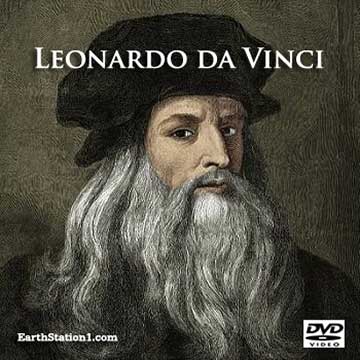
April 15, 1452: #BOTD: #HBD! Leonardo da
Vinci, Italian Renaissance polymath whose areas of interest
included invention, painting, sculpting, architecture, science,
music, mathematics, engineering, literature, anatomy, geology,
astronomy, botany, writing, history, and cartography (d. May 2,
1519) is #born Leonardo di ser Piero da Vinci in, or close to, the
Tuscan hill town of Vinci, 20 miles from Florence. Commonly known
as Leonardo or da Vinci, Leonardo da Vinci has been variously
called the father of palaeontology, ichnology, and architecture,
and is widely considered one of the greatest painters of all time.
Credited with the inventions of the parachute, helicopter and
tank, he epitomised the Renaissance humanist ideal. Many
historians and scholars regard Leonardo as the prime exemplar of
the "Universal Genius" or "Renaissance Man",
an individual of "unquenchable curiosity" and
"feverishly inventive imagination", and he is widely
considered one of the most diversely talented individuals ever to
have lived. The scope and depth of his interests were without
precedent in recorded history. While there is much speculation
regarding his life and personality, his view of the world was
logical rather than mysterious, and that the empirical methods he
employed were unorthodox for his time. Born out of wedlock to a
notary, Piero da Vinci, and a peasant woman, Caterina, in Vinci in
the region of Florence, Leonardo was educated in the studio of the
renowned Florentine painter Andrea del Verrocchio. Much of his
earlier working life was spent in the service of Ludovico il Moro
in Milan. He later worked in Rome, Bologna and Venice, and he
spent his last years in France at the home awarded to him by
Francis I of France. Leonardo was, and is, renowned primarily as a
painter. Among his works, the Mona Lisa is the most famous and
most parodied portrait, and The Last Supper the most reproduced
religious painting of all time. Leonardo's drawing of the
Vitruvian Man is also regarded as a cultural icon, being
reproduced on items as varied as the euro coin, textbooks, and
T-shirts. A painting by Leonardo, Salvator Mundi, sold for a world
record 450.3M USD at a Christie's auction in New York, 15 November
2017, the highest price ever paid for a work of art. Perhaps
fifteen of his paintings have survived. Nevertheless, these few
works, together with his notebooks, which contain drawings,
scientific diagrams, and his thoughts on the nature of painting,
compose a contribution to later generations of artists rivalled
only by that of his contemporary, Michelangelo. Leonardo is
revered for his technological ingenuity. He conceptualised flying
machines, a type of armoured fighting vehicle, concentrated solar
power, an adding machine, and the double hull. Relatively few of
his designs were constructed or even feasible during his lifetime,
as the modern scientific approaches to metallurgy and engineering
were only in their infancy during the Renaissance. Some of his
smaller inventions, however, such as an automated bobbin winder
and a machine for testing the tensile strength of wire, entered
the world of manufacturing unheralded. A number of Leonardo's most
practical inventions are nowadays displayed as working models at
the Museum of Vinci. He made substantial discoveries in anatomy,
civil engineering, geology, optics, and hydrodynamics, but he did
not publish his findings and they had no direct influence on later
science. Leonardo da Vinci died at Clos Luce, France on at the age
of 67, possibly of a stroke. King Francis I of France had become a
close friend. Giorgio Vasari (Italian Renaissance Master, who
worked as a painter, architect, engineer, writer, and historian,
who is best known for his work The Lives of the Most Excellent
Painters, Sculptors, and Architects, considered the ideological
foundation of all art-historical writing, and the basis for
biographies of several Renaissance artists, including Leonardo da
Vinci and Michelangelo), describes Leonardo as lamenting on his
deathbed, full of repentance, that "he had offended against
God and men by failing to practice his art as he should have
done." Vasari states that in his last days, Leonardo sent for
a priest to make his confession and to receive the Holy Sacrament.
Vasari also records that the King Francis I held Leonardo's head
in his arms as he died, although this story may be legend rather
than fact. In accordance with his will, sixty beggars carrying
tapers followed Leonardo's casket. Count Francesco Melzi, da
Vinci's friend and apprentice who painted the only certain
contemporary depiction of Leonardo, was the principal heir and
executor, receiving, as well as money, Leonardo's paintings,
tools, library and personal effects. Leonardo's other long-time
pupil and companion, Salai, and his servant Baptista de Vilanis,
each received half of Leonardo's vineyards. His brothers received
land, and his serving woman received a fur-lined cloak. On August
12, 1519, Leonardo's remains were interred in the Collegiate
Church of Saint Florentin at the Chateau d'Amboise. On Sale @ 15%
Off Discount Till Midnight PT!
https://store.earthstation1.com/leonardo-da-vinci-documentary-dvd-mp4-video-download-usb-flash-driv4.html
Today's
EarthStation1.com 15% Off Commemorative Memorial Title: NBC
University Theater Of The Air Literature Radio Series MP3 DVD USB
Today, April 15, 2026
April 15, 1843: #BOTD: #HBD! Henry James,
American-British novelist, short story writer and critic, regarded
as a key transitional figure between literary realism and literary
modernism, considered by many to be among the greatest novelists
in the English language (d. February 28, 1916) is #born at 21
Washington Place in New York City, the son of Henry James Sr. and
the brother of renowned philosopher and psychologist William James
and diarist Alice James. He is best known for a number of novels
dealing with the social and marital interplay between emigre
Americans, English people, and continental Europeans. Examples of
such novels include The Portrait of a Lady, The Ambassadors, and
The Wings of the Dove. His later works were increasingly
experimental. In describing the internal states of mind and social
dynamics of his characters, James often made use of a style in
which ambiguous or contradictory motives and impressions were
overlaid or juxtaposed in the discussion of a character's psyche.
For their unique ambiguity, as well as for other aspects of their
composition, his late works have been compared to impressionist
painting. His novella The Turn of the Screw has garnered a
reputation as the most analysed and ambiguous ghost story in the
English language and remains his most widely adapted work in other
media. He also wrote a number of other highly regarded ghost
stories and is considered one of the greatest masters of the
field. James published articles and books of criticism, travel,
biography, autobiography, and plays. Born in the United States,
James largely relocated to Europe as a young man and eventually
settled in England, becoming a British subject in 1915, one year
before his death. James was nominated for the Nobel Prize in
Literature in 1911, 1912 and 1916. Henry James died of pneumonia
in Chelsea, London, aged 72. He was cremated at Golders Green
Crematorium, and as he requested, his ashes were buried in
Cambridge Cemetery in Massachusetts. On Sale @ 15% Off Discount
Till Midnight PT!
https://store.earthstation1.com/nbc-university-theater-of-the-air-otr-mp3-dv3.html
Today's
EarthStation1.com 15% Off Commemorative Memorial Title: Abraham
Lincoln Radio Show MP3 Set CD, Audio Download, USB Flash Drive
Today, April 15, 2026
April 15, 1861: The American Civil War
(The Civil War, The War Between The States): Events Leading To The
American Civil War: President Lincoln's 75,000 Volunteers: --
President Abraham Lincoln calls for a 75,000 volunteer militia to
serve for three months following the bombardment and surrender of
Fort Sumter to quell the insurrection that soon became the
American Civil War. Some southern states refused to send troops
against the neighboring Deep South slave states of South Carolina,
Mississippi, Florida, Alabama, Georgia, Louisiana, and Texas. The
result was that most states in the Upper South of Virginia,
Arkansas, North Carolina, and Tennessee also declared secession
from the United States and joined the Confederate States. In
Missouri and Kentucky, pro-Confederate state governments were
formed. Although neither managed to seize effective control, they
were duly recognized by the Confederacy with these states being
admitted as the 12th and 13th Confederate states, respectively.
Meanwhile, movement towards secession was forcibly suppressed by
Federal troops in Maryland and not attempted in Delaware, with
both states staying in the Union throughout the duration of the
war. On Sale @ 15% Off Discount Till Midnight PT!
https://store.earthstation1.com/abraham-lincoln-radio-show-mp3-set-cd-download-us3.html
Today's
EarthStation1.com 15% Off Commemorative Memorial Title: The
Assassination Of Abraham Lincoln MP4 Video Download DVD
Today, April 15, 2026
April 15, 1865: United States
Presidential Assassination Attempts And Plots: The Assassination
Plots Against Abraham Lincoln: The Assassination Of Abraham
Lincoln: -- #DOTD: #RIP: President Abraham Lincoln, the 16th
President of the United States (b. February 12, 1809) #dies at
7:22 a.m after being shot the previous evening by actor John
Wilkes Booth while attending the play Our American Cousin at
Ford's Theatre in Washington, D.C. Vice President Andrew Johnson,
becomes President upon Lincoln' death. Shot in the head as he
watched the play, Lincoln died in the Petersen House opposite the
theater. He was the first American president to be assassinated;
his funeral and burial marked an extended period of national
mourning. Occurring near the end of the American Civil War, the
assassination was part of a larger conspiracy which included Lewis
Powell, David E. Herold, Michael O'Laughlen, Mary E. Surratt, John
Surratt, Edman Spangler, Samuel Arnold and George A. Atzerodt, and
was intended by Booth to revive the Confederate cause by
eliminating the three most important officials of the United
States government. Conspirators Lewis Powell and David Herold were
assigned to kill Secretary Of State William H. Seward, and George
Atzerodt was tasked with killing Vice President Andrew Johnson.
Beyond Lincoln's death the plot failed: Seward was only wounded
and Johnson's would-be attacker lost his nerve. After a dramatic
initial escape, Booth was killed at the climax of a 12-day
manhunt, and several other conspirators were later hanged. Lincoln
's death triggered a funeral extravaganza, one the country had
never seen before. After a service and procession down
Pennsylvania Avenue, Lincoln's embalmed body, along with that of
his son Willie (disinterred from a Washington., D.C. cemetery) was
placed aboard a Funeral Train for the trip home to Springfield,
Illinois. Sixteen days later, with arrival in Springfield, the
odyssey came to an end. At Oak Ridge Cemetery, the remains of
Willie and the President were placed in a temporary vault. His son
Eddie was disinterred later from nearby Hutchinson's Cemetery and
also placed in the temporary chamber. The final resting place of
Abraham Lincoln is The Lincoln Tomb in Oak Ridge Cemetery; his
wife Mary Todd Lincoln; and three of their four sons -- Edward,
William, and Thomas -- are all interred there. There are numerous
memorials, namesake places, portraits on money, and artifacts of
President Lincoln. On February 12, 1914, the first stone of the
Lincoln Memorial was put into place. The family tree has gone
extinct; the last heir, his great-grandson, Robert Todd Lincoln
Beckwith, died on Christmas Eve in 1985. Any direct descendant
could have inherited Beckwith's fortune, estimated at 3M USD. It
has since been given to charity. Abraham Lincoln was born in
Hodgenville, Hardin County, Kentucky. Lincoln led the United
States through its Civil War, its bloodiest war and perhaps its
greatest moral, constitutional, and political crisis. In doing so,
he preserved the Union, paved the way for the abolition of
slavery, strengthened the federal government, modernized the
economy and established the Thanksgiving holiday. Largely
self-educated, he became a lawyer in Illinois, a Whig Party
leader, and was elected to the Illinois House of Representatives,
in which he served for eight years. Elected to the United States
House Of Representatives in 1846, Lincoln promoted rapid
modernization of the economy and opposed the Mexican-American War.
After a single term, he returned to Illinois and resumed his
successful law practice. Reentering politics in 1854, he became a
leader in building the new Republican Party, which had a statewide
majority in Illinois. As part of the 1858 campaign for US Senator
from Illinois, Lincoln took part in a series of highly publicized
debates with his opponent and rival, Democrat Stephen A. Douglas;
Lincoln spoke out against the expansion of slavery, but lost the
race to Douglas. In 1860, Lincoln secured the Republican Party
presidential nomination as a moderate from a swing state, though
most delegates originally favored other candidates. Though he
gained very little support in the slaveholding states of the
South, he swept the North and was elected president in 1860.
Though there were attempts to bridge the differences between North
and South, ultimately Lincoln's victory prompted seven southern
slave states to secede from the United States and form the
Confederate States of America before he moved into the White
House. The Confederate attack on Fort Sumter inspired the North to
rally behind the Union. His Gettysburg Address became an iconic
endorsement of nationalism, republicanism, equal rights, liberty,
and democracy. He suspended habeas corpus, leading to the
controversial ex parte Merryman decision, and he averted potential
British intervention by defusing the Trent Affair. Lincoln closely
supervised the war effort, especially the selection of generals,
including his most successful general, Ulysses S. Grant. He made
major decisions on Union war strategy, including a naval blockade
that shut down the South's trade. As the war progressed, his
complex moves toward ending slavery included the Emancipation
Proclamation of 1863; Lincoln used the U.S. Army to protect
escaped slaves, encouraged the border states to outlaw slavery,
and pushed through Congress the Thirteenth Amendment to the United
States Constitution, which permanently outlawed slavery. An astute
politician deeply involved with power issues in each state,
Lincoln reached out to the War Democrats and managed his own
re-election campaign in the 1864 presidential election.
Anticipating the war's conclusion, Lincoln pushed a moderate view
of Reconstruction, seeking to reunite the nation speedily through
a policy of generous reconciliation in the face of lingering and
bitter divisiveness. Lincoln has been consistently ranked both by
scholars and the public as among the greatest U.S. presidents.
#AssassinationOfAbrahamLincoln #LincolnAssassination
#AbrahamLincoln #PresidentsOfTheUS #POTUS #POTUSHistory
#AmericanPresidents #Assassinations #PresidentsOfTheUS
#POTUSAssassinations #Conspiracies #LincolnAssassinationConspiracy
#JohnWilkesBooth #LewisPowell #DavidEHerold #MichaelOLaughlen
#MaryESurratt #JohnSurratt #EdmanSpangler #SamuelArnold
#GeorgeAAtzerodt #FordsTheatre #OurAmericanCousin #WashingtonDC
#PetersenHouse #WilliamHSeward #AndrewJohnson #AmericanCivilWar
#WarBetweenTheStates #AmericanHistory #HistoryOfTheUS
#WesternCulture #WesternCivilization #OccidentalCulture
#WesternWorld #WesternSociety #WesternTradition
#StoryOfCivilization #MP4 #VideoDownload #DVD On Sale @ 15% Off
Discount Till Midnight PT!
https://store.earthstation1.com/the-assassination-of-abraham-lincoln-mp4-video-download-dvd.html
Today's
EarthStation1.com 15% Off Commemorative Memorial Title: Black
Civil Rights Films: African-American History DVD, MP4, USB Stick
Today, April 15, 2026
April 15, 1889: #BOTD: #HBD! A. Philip
Randolph, African American labor union and civil rights leader,
the eldest of the "Big Six" civil rights leaders
instrumental in the organization of The March On Washington For
Jobs And Freedom of which Randolph was the head (d. May 16, 1979)
is #born Asa Philip Randolph in Crescent City, Florida. In 1925,
he organized and led the Brotherhood of Sleeping Car Porters, the
first successful African American led labor union. In the early
Civil Rights Movement and the Labor Movement, Randolph was a
prominent and influential voice. His continuous agitation with the
support of fellow labor rights activists against racist unfair
labor practices, eventually helped lead President Franklin D.
Roosevelt to issue Executive Order 8802 in 1941, banning
discrimination in the defense industries during World War II,
resulting in the founding of the Fair Employment Practice
Committee to implement it. Randolph and other activists then
successfully maintained pressure, so that President Harry S.
Truman proposed a new Civil Rights Act, and issued in 1948
Executive Orders 9980 and 9981 that were against discrimination,
promoted fair employment, established anti-discrimination policies
in federal government hiring, and ending racial segregation in the
armed services. In 1963, Randolph was the head of the March On
Washington, which was organized by Bayard Rustin, at which
Reverend Martin Luther King Jr. delivered his "I Have A
Dream" speech. Randolph inspired the "Freedom Budget",
sometimes called the "Randolph Freedom budget", which
aimed to deal with the economic problems facing the black
community, it was published by the Randolph Institute in January
1967 as "A Freedom Budget for All Americans". Although
he was able to attain a good education in his community at Cookman
Institute, he did not see a future for himself in the
discriminatory Jim Crow era south, and moved to New York City just
before the Great Migration (the movement of six million African
Americans out of the rural Southern United States to the urban
Northeast, Midwest, and West between 1910 and 1970). There he
became convinced that overcoming racism required collective
action, and he was drawn to socialism and workers' rights. He
unsuccessfully ran for state office on the socialist ticket in the
early twenties, but found more success in organizing for African
American workers' rights. In 1963, Randolph was the head of the
March On Washington, which was organized by Bayard Rustin, at
which Reverend Martin Luther King Jr. delivered his "I Have A
Dream" speech. Randolph inspired the "Freedom Budget",
sometimes called the "Randolph Freedom budget", which
aimed to deal with the economic problems facing the black
community, it was published by the Randolph Institute in January
1967 as "A Freedom Budget for All Americans". A. Philip
Randolph died in his Manhattan apartment aged 90 after several
years of suffering a heart condition and high blood pressure. He
had no known living relatives when he died, as his wife Lucille
had died in 1963, before the March on Washington. His remains were
cremated, and his ashes are kept in an urn at the headquarters of
the A. Philip Randolph Institute, Washington, D.C.. On Sale @ 15%
Off Discount Till Midnight PT!
https://store.earthstation1.com/black-civil-rights-films-africanamerican-history-dvd.html
Today's
EarthStation1.com 15% Off Commemorative Memorial Title: Vintage
Nude Photos Art History 40K+ JPG Image Set DVD, Download, USB
Today, April 15, 2026
April 15, 1889: #BOTD: #HBD! Thomas Hart
Benton, American painter, muralist, printmaker and educator (d.
January 19, 1975) is #born in Neosho, Missouri, into an
influential family of politicians. Along with Grant Wood and John
Steuart Curry, he was at the forefront of the Regionalist art
movement. The fluid, sculpted figures in his paintings showed
everyday people in scenes of life in the United States. His work
is strongly associated with the Midwestern United States, the
region in which he was born and which he called home for most of
his life. He also studied in Paris, lived in New York City for
more than 20 years and painted scores of works there, summered for
50 years on Martha's Vineyard off the New England coast, and also
painted scenes of the American South and West. Thomas Hart Benton
died at work in his studio in Kansas City, Missouri as he
completed his final mural, "The Sources Of Country Music",
for the Country Music Hall of Fame in Nashville, Tennessee, aged
85. His remains were cremated, and his ashes were scattered over
Martha's Vinyard, Massachusetts. On Sale @ 15% Off Discount Till
Midnight PT!
https://store.earthstation1.com/vintage-nude-photos-dvd-40000-pics-nudes-in-art-and-hi40000.html
Today's
EarthStation1.com 15% Off Commemorative Memorial Title: Nikita
Khrushchev Biography Documentary Set MP4 Video Download DVD
Today, April 15, 2026
April 15, 1894: #BOTD: Nikita Khrushchev,
Russian general and politician, 7th Premier of the Soviet Union
(d. September 11, 1971) is #born Nikita Sergeyevich Khrushchev in
Kalinovka village in what is now Russia's Kursk Oblast. Khrushchev
led the Soviet Union during a critical part of the Cold War. He
served as First Secretary of the Communist Party of the Soviet
Union from 1953 to 1964, and as Chairman of the Council of
Ministers, or Premier, from 1958 to 1964. During his rule,
Khrushchev stunned the communist world with his denunciation of
Stalin's crimes. Khrushchev was responsible for the
de-Stalinization of the Soviet Union, for backing the progress of
the early Soviet space program, and for several relatively liberal
reforms in areas of domestic policy. After some false starts, and
a narrowly avoided nuclear war over Cuba, he conducted successful
negotiations with the United States to reduce Cold War tensions.
His proclivity toward recklessness led the Kremlin leadership to
strip him of power, replacing him with Leonid Brezhnev as First
Secretary and Alexei Kosygin as Premier. Nikita Khrushchev died of
a heart attack around noon in the Kremlin hospital in Moscow at
the age of 77. He was denied a state funeral with interment in the
Kremlin Wall and was instead buried in the Novodevichy Cemetery in
Moscow. Fearing demonstrations, the authorities did not announce
Khrushchev's death until the hour of his wake and surrounded the
cemetery with troops. Even so, some artists and writers joined the
family at the graveside for the interment. Pravda ran a
one-sentence announcement of the former premier's death; Western
newspapers contained considerable coverage. Veteran New York Times
Moscow correspondent Harry Schwartz wrote of Khrushchev, "Mr.
Khrushchev opened the doors and windows of a petrified structure.
He let in fresh air and fresh ideas, producing changes which time
already has shown are irreversible and fundamental." On Sale
@ 15% Off Discount Till Midnight PT!
https://store.earthstation1.com/nikita-khrushchev-documentaries-dvd.html
Today's
EarthStation1.com 15% Off Commemorative Memorial Title: John
Hammond: Bessie Smith to Bruce Springsteen DVD, MP4, Flash Drive
Today, April 15, 2026
April 15, 1894: #BOTD: #HBD! Bessie
Smith, African American jazz and blues singer and actress
nicknamed "The Empress Of The Blues', the most popular female
blues singer of the 1920s and 1930s, regarded as one of the
greatest singers of her era and a major influence on other jazz
singers (d. September 26, 1937) is #born in Chattanooga,
Tennessee. Both sides of her first record, "Downhearted
Blues" backed with "Gulf Coast Blues", were hits.
She sold so many records that her sales were sometimes officially
measured by the ton rather than by the copy. Smith became a
headliner on the black-owned Theater Owners Booking Association
(T.O.B.A.) circuit and rose to become its top attraction in the
1920s. Ironically, her success resulted in southern record dealers
insisting that her record company, Columbia, indicate that a black
perfomer was featured on the record so that the record store
owners would not be accused by white customers of selling records
by black performers on an equal footing to those featuring the
white performers that Smith was outselling. As a result, Columbia
created a separate numbering system for all their records by black
artists, the 13000 series, so that record dealers could
distinguish them from the rest of their catalog. Working a heavy
theater schedule during the winter and performing in tent shows
the rest of the year (eventually traveling in her own railroad
car), Smith became the highest-paid black entertainer of her day.
Columbia nicknamed her "Queen of the Blues," but the
press soon upgraded her title to "Empress of the Blues".
Smith's music stressed independence, fearlessness, and sexual
freedom, implicitly arguing that working-class women did not have
to alter their behavior in order to be worthy of respect. Smith
had a strong contralto voice, which recorded well from her first
session, which was conducted when recordings were made
acoustically. With the advent of electrical recording (her first
electrical recording was "Cake Walking Babies [From Home]",
recorded on May 5, 1925), the sheer power of her voice was even
more evident. She was also able to benefit from the new technology
of radio broadcasting, even on stations in the segregated South.
For example, after giving a concert for a white-only audience at a
theater in Memphis, Tennessee, in October 1923, she then performed
a late-night concert on station WMC, which was well received by
the radio audience. She made 160 recordings for Columbia, often
accompanied by the finest musicians of the day, notably Louis
Armstrong, Coleman Hawkins, Fletcher Henderson, James P. Johnson,
Joe Smith, and Charlie Green. In 1929, Smith made her only film
appearance, starring in a two-reeler, St. Louis Blues, based on W.
C. Handy's song of the same name. In the film, directed by Dudley
Murphy and shot in Astoria, Queens, she sings the title song
accompanied by members of Fletcher Henderson's orchestra, the Hall
Johnson Choir, the pianist James P. Johnson and a string section,
a musical environment radically different from that of any of her
recordings. Bessie Smith died at the age of 43 in a car crash
while traveling along U.S. Route 61 between Memphis, Tennessee,
and Clarksdale, Mississippi. Her common law husband, Richard
Morgan, nephew of jazz vibraphoniest Lionel Hampton, was driving
and misjudged the speed of a slow-moving truck ahead of him. Tire
marks at the scene suggested that Morgan tried to avoid the truck
by driving around its left side, but he hit the rear of the truck
side-on at high speed. Smith's funeral was held in Philadelphia a
little over a week later, on October 4, 1937. Initially, her body
was laid out at Upshur's Funeral Home. As word of her death spread
through Philadelphia's black community, her body had to be moved
to the O. V. Catto Elks Lodge to accommodate the estimated 10,000
mourners who filed past her coffin on Sunday, October 3.
Contemporary newspapers reported that her funeral was attended by
about seven thousand people. Far fewer mourners attended the
burial at Mount Lawn Cemetery, in nearby Sharon Hill,
Pennsylvania. Her estranged husband Jack Gee thwarted all efforts
to purchase a stone for his estranged wife's grave, even once or
twice pocketing money raised for that purpose. Smith's grave
remained unmarked until a tombstone was erected on August 7, 1970,
paid for by the singer Janis Joplin and Juanita Green, who as a
child had done housework for Smith. Dory Previn wrote a song about
Joplin and the tombstone, "Stone For Bessie Smith", for
her album Mythical Kings and Iguanas. The Afro-American Hospital
(now the Riverside Hotel) was the site of the dedication of the
fourth historical marker on the Mississippi Blues Trail. On Sale @
15% Off Discount Till Midnight PT!
https://store.earthstation1.com/john-hammond-from-bessie-smith-to-bruce-springsteen-dvd.html
Today's
EarthStation1.com 15% Off Commemorative Memorial Title: Fibber
McGee And Molly Complete Radio Series MP3 DVD, Download, USB
Today, April 15, 2026
April 15, 1898: #BOTD: #HBD! Marian
Driscoll Jordan, American actress and radio personality most
remembered for portraying the role of Molly McGee, the patient,
common sense, honey-natured wife of Fibber McGee on the NBC radio
series Fibber McGee and Molly from 1935-1959 (d. April 7, 1961) is
#born Marian Irene Driscoll in Peoria, Illinois. She starred on
this series opposite her real-life husband Jim Jordan. She was
born Marian Irene Driscoll on April 15, 1898 in Peoria, Illinois.
As a teenager and young adult, Driscoll gave music lessons and
sang in choir at the church which she attended. While at choir
practice one day, she met a member of the choir named James Edward
"Jim" Jordan. The two were married on August 31, 1918.
They had two children together; a son and a daughter. The couple
went on to have a long career in show business. Their life as
newlyweds started humbly. Marian became a piano teacher and Jim a
mailman. Jim enlisted in the army and was eventually stationed in
France during World War One. He contracted a case of influenza
during the 1918 flu pandemic but survived. After the war ended,
Jim stayed in Europe to do Vaudeville performances for wounded
soldiers. When Jim returned he went on the vaudeville circuit,
both as a solo act and with Marian, at various times until 1924.
They went entirely broke in 1923, having to be wired money by
their parents to get back to Peoria from Lincoln, Illinois. Jim
and Marian Jordan got their major break in radio while performing
in Chicago in 1924; Jim said he could give a better performance
than the singers they were listening to on the radio, and his
brother Byron bet 10 USD that Jim couldn't do it. By the end of
the evening, Jim and Marian had their first radio contract, at 10
USD per show for 26 weeks as The O'Henry Twins, sponsored by Oh
Henry! candy. The Jordans would work as a double act for the
remainder of their careers, seldom appearing separate from each
other, with Jim as the comic foil and Marian as the stooge. From
1931 to 1935, they produced the low-budget sitcom Smackout, in
which they portrayed most of the characters (including
semi-fictional versions of themselves). In 1935, the couple, along
with head writer Don Quinn, teamed up to create Fibber McGee and
Molly, a weekly sitcom that was given a larger budget and an
ensemble cast. Fibber McGee and Molly ran as a weekly series until
1953. In addition to the general decline of scripted radio and the
concurrent rise of television, Marian's health was beginning to
fail. The show would transition to a pre-recorded daily sitcom
from 1953 to 1956, then to a short-form weekly series (under the
name Just Molly and Me) for Monitor from 1957 to 1959. In 1959,
Fibber McGee and Molly was finally adapted for television, after
years of resistance. Marian's health slowly deteriorated beginning
in 1938 during the run of Fibber McGee and Molly. She battled
alcoholism, and entered a rehabilitation center. She returned to
radio in April, 1939. By 1953, she became easily exhausted and
fatigued. A doctor suggested she take a long rest, but she
refused, deciding instead to continue performing. The Fibber McGee
and Molly program was then recorded from the Jordan's home in
Encino. The music was pre-recorded, and the commercials were no
longer part of the show, but her failing health soon ended the
Fibber McGee and Molly show. For reasons unexplained (nothing in
the radio series had identified the age of either of the McGees),
neither Jim nor Don Quinn (nor Quinn's successor as head writer of
the radio show, Phil Leslie) transitioned to the new series; new
writers were brought in, and both the McGees were recast. The
television version of Fibber McGee and Molly, with Bob Sweeney as
Fibber, was a critical and commercial failure. In 1958, Marian was
found to have an inoperable form of cancer. She died at her home
in Encino on April 7, 1961, of cancer. She is buried next to Jim
Jordan in the Saint Ann section of Holy Cross Cemetery, Culver
City. On Sale @ 15% Off Discount Till Midnight PT!
https://store.earthstation1.com/fibber-mcgee-and-molly-mp3-dvd-complete-radio-serie3.html
Today's
EarthStation1.com 15% Off Commemorative Memorial Title: The
Parade: North Korea Celebrates 40th Anniversary DVD, Download, USB
Today, April 15, 2026
April 15, 1912: #BOTD: Kim Il-Sung, North
Korean general and politician, 1st Supreme Leader of North Korea
(d. July 8, 1994) is #born Kim Song-ju in Namni, South Heian
Province, Korea. He was the first Supreme Leader of North Korea,
from its establishment in 1948 until his death in 1994. He held
the posts of Premier from 1948 to 1972 and President from 1972 to
1994. He was also the leader of the Workers' Party of Korea (WPK)
from 1949 to 1994 (titled Chairman from 1949 to 1966 and General
Secretary after 1966). Coming to power after the end of Japanese
rule in 1945, he authorized the invasion of South Korea in 1950,
triggering an intervention in defense of South Korea by the United
Nations led by the United States. Following the military stalemate
in the Korean War, a ceasefire was signed on 27 July 1953. He was
the second longest-serving non-royal head of state/government in
the 20th century, in office for more than 48 years. Under his
leadership, North Korea became a communist state with a publicly
owned and planned economy. It had close political and economic
relations with the Soviet Union. By the 1960s, North Korea enjoyed
a relatively high standard of living, outperforming the South,
which was fraught with political instability and economic crises.
The situation reversed in the late 1980s, as a newly stable South
Korea became an economic powerhouse fueled by Japanese and
American investment, military aid and internal economic
development while North Korea stagnated. Differences emerged
between North Korea and the Soviet Union, central among them Kim
Il-Sung's philosophy of Juche, which focused on Korean nationalism
and self-reliance. Despite this, the country received funds,
subsidies and aid from the USSR (and the Eastern Bloc) until the
dissolution of the USSR in 1991. The resulting loss of economic
aid adversely affected the North's economy, causing widespread
famine in 1994. During this period, North Korea also remained
critical of the United States defense force's presence in the
region, which it considered imperialism, having seized the
American ship USS Pueblo (AGER-2) in 1968. He outlived Joseph
Stalin by four decades and Mao Zedong by two and remained in power
during the terms of office of six South Korean Presidents, ten
U.S. Presidents and twenty-one Japanese Prime Ministers. Known as
the Great Leader (Suryong), he was the focus of a personality cult
which dominated domestic politics in North Korea. At the 6th WPK
Congress in 1980, his son Kim Jong-il was elected as a Presidium
member and chosen as his heir apparent to the supreme leadership.
Kim Il-Sung's birthday is a public holiday in North Korea called
the "Day of the Sun". In 1998, Kim Il-Sung was given the
title "Eternal President of the Republic". During his
rule, North Korea was widely characterized as a totalitarian state
with widespread human rights abuses, including mass executions and
prison camps. Kim Il-Sung died at 2:00am of a heart attack at age
82. In the late morning shortly before 12:00 noon on July 7 1994,
Kim Il Sung collapsed from a sudden heart attack at his residence
in Hyangsan, North Pyongan. His son and heir Kim Jong Il ordered
the team of doctors who were constantly at his father's side to
leave, and arranged for the country's best doctors to be flown in
from Pyongyang. After several hours, the doctors from Pyongyang
arrived, but despite their efforts to save him, Kim Il Sung died.
Kim Jong-Il began to assume supreme leadership of North Korea
immediately upon his death. After the traditional Confucian
mourning period, his death was declared 34 hours later. Kim Il
Sung's death resulted in nationwide mourning and a ten-day
mourning period was declared by Kim Jong Il. His funeral was
scheduled to be held on July 17 1994 in Pyongyang, but was delayed
until July 19. It was attended by hundreds of thousands of people
who were flown into the city from all over North Korea. Kim Il
Sung's body was placed in a public mausoleum at the Kumsusan
Palace of the Sun, where his preserved and embalmed body lies
under a glass coffin for viewing purposes. His head rests on a
traditional Korean pillow and he is covered by the flag of the
Workers' Party of Korea. Newsreel video of the funeral at
Pyongyang was broadcast on several networks, and can now be found
on various websites. Kim Il-Sung was born Kim Song-ju in Namni,
South Heian Province, Korea. On Sale @ 15% Off Discount Till
Midnight PT!
https://store.earthstation1.com/the-parade-dvd-north-korea-rallies-during-1988-seoul-olym1988.html
Today's
EarthStation1.com 15% Off Commemorative Memorial Title: Jack Paar
Late-Night TV Talk Shows DVD, MP4 Download, USB Flash Drive
Today, April 15, 2026
April 15, 1917: #BOTD: #HBD! Hans
Conried, American actor, voice actor and comedian in movies, radio
and television (d. January 5, 1982) is #born Hans Georg Conried,
Jr. in Baltimore, Maryland to a Connecticut-born mother who was a
descendant of Pilgrims, and a Jewish immigrant father from Vienna,
Austria. Hans Conried was very active in voice-over roles and
known for providing the voices of Walt Disney's Mr. George
Darling, and Captain Hook in Peter Pan (1953), for playing the
title role in The 5,000 Fingers of Dr. T, Dr. Miller on The George
Burns and Gracie Allen Show, Professor Kropotkin on the radio and
film versions of My Friend Irma, his work as Uncle Tonoose on
Danny Thomas's sitcom Make Room for Daddy, and multiple roles on I
Love Lucy. He was a regular guest on Jack Paar's Tonight Show. He
was a regular on the radio series The Judy Canova Show and played
Snidely Whiplash on TV's The Rocky And Bullwinkle Show. Hans
Conried died one day after suffering a major heart attack in
Burbank, California, aged 64. His body was donated to medical
science. On Sale @ 15% Off Discount Till Midnight PT!
https://store.earthstation1.com/jack-paar-tv-shows-old-time-television-dual-layer-dvd.html
Today's
EarthStation1.com 15% Off Commemorative Memorial Title: The Age Of
Ballyhoo: The 1920s With Gloria Swanson DVD, Download, USB
Today, April 15, 2026
April 15, 1920: Anti-Communism In The
United States: Red Scare: The First Red Scare: Sacco And Vanzetti:
The Slater-Morrill Shoe Company Factory Robbery: -- #DOTD: #RIP:
Two security guards are murdered during a robbery in South
Braintree, Massachusetts; on May 5, 1920, authorities arrested
Nicola Sacco and Bartolomeo Vanzetti for alleged robbery and
murder. They were later convicted of murdering a guard and a
paymaster during the April 15, 1920 armed robbery of the Slater
and Morrill Shoe Company in Braintree, Massachusetts, United
States. They were executed in the electric chair seven years later
at Charlestown State Prison. Both men adhered to an anarchist
movement that advocated relentless warfare against a violent and
oppressive government. A series of appeals followed, funded
largely by the private Sacco And Vanzetti Defense Committee. The
appeals were based on recanted testimony, conflicting ballistics
evidence, a prejudicial pre-trial statement by the jury foreman,
and a confession by an alleged participant in the robbery. All
appeals were denied by trial judge Webster Thayer and also later
denied by the Massachusetts State Supreme Court. By 1926, the case
had drawn worldwide attention. As details of the trial and the
men's suspected innocence became known, Sacco And Vanzetti became
the center of one of the largest causes celebres in modern
history. In 1927, protests on their behalf were held in every
major city in North America and Europe, as well as in Tokyo,
Sydney, Sao Paulo, Rio de Janeiro, Buenos Aires, and Johannesburg.
Celebrated writers, artists, and academics pleaded for their
pardon or for a new trial. Harvard law professor and future
Supreme Court justice Felix Frankfurter argued for their innocence
in a widely read Atlantic Monthly article that was later published
in book form. Sacco And Vanzetti were scheduled to die in April
1927, accelerating the outcry. Responding to a massive influx of
telegrams urging their pardon, Massachusetts governor Alvan T.
Fuller appointed a three-man commission to investigate the case.
After weeks of secret deliberation that included interviews with
the judge, lawyers, and several witnesses, the commission upheld
the verdict. Sacco And Vanzetti were executed in the electric
chair just after midnight on August 23, 1927. Subsequent riots
destroyed property in Paris, London, and other cities. On Sale @
15% Off Discount Till Midnight PT!
https://store.earthstation1.com/the-age-of-ballyhoo-dvd-1920s-documentary-gloria-swa1920.html
Today's
EarthStation1.com 15% Off Commemorative Memorial Title: The Good
Old Time TV Theme Song MP3 CD, Audio Download, USB Drive
Today, April 15, 2026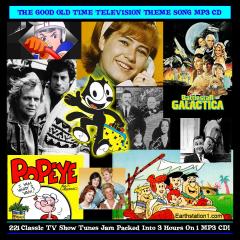
April 15, 1933: #BOTD: #HBD! Elizabeth
Montgomery, American actress and beauty whose career spanned five
decades in film, stage, and television, best known as the good
witch Samantha Stephens on the popular television series Bewitched
(d. May 18, 1995) is #born Elizabeth Victoria Montgomery to
Broadway actress Elizabeth Daniel Bryan Allen and film star actor,
director and producer Robert Montgomery. Elizabeth Montgomery
began her career in the 1950s with a role on her father's
television series Robert Montgomery Presents, and she won a
Theater World Award for her 1956 Broadway debut in the production
Late Love. In the 1960s, she was celebrated for her role as
Samantha Stephens on the ABC sitcom Bewitched. Her work on the
series earned her five Primetime Emmy Award nominations and four
Golden Globe Award nominations. After Bewitched ended its run in
1972, Montgomery continued her career with roles in numerous
television films, including A Case of Rape (1974), as Ellen
Harrod, and The Legend of Lizzie Borden (1975), as Lizzie Borden.
Both roles earned her additional Emmy Award nominations.
Throughout her career, Montgomery was devoted to various forms of
liberal political activism and charitable work. She lent her name,
along with a large amount of her time, money, and energy, to a
wide variety of charitable and political causes. She was a
champion of women's rights, AIDS activism, and gay rights. She was
also an ardent critic of the Vietnam War, and in later years, she
was an active advocate for AIDS research and outreach to the
disabled community. Professionally, she lent her voice as the
narrator of two political documentaries which were critical of
U.S. foreign policy, Cover Up: Behind the Iran Contra Affair
(1988) and its Academy Award-winning sequel The Panama Deception
(1992). In June 1992, Montgomery and her former Bewitched co-star
and good friend Dick Sargent, were grand marshals at the Los
Angeles Gay Pride Parade. During the last year of her life,
Montgomery was a volunteer at the Los Angeles Unit of Learning
Ally, a nonprofit organization which records educational books on
specially formatted CDs as well as in downloadable formats for
disabled people. In 1994, Montgomery produced several radio and
television public-service announcements for Learning Ally's Los
Angeles unit. In January 1995, she recorded the 1952 edition of
the best-selling book of poetry titled When We Were Very Young by
A. A. Milne for Learning Ally. At 8:22 a.m. Pacific time,
Elizabeth Montgomery died in her sleep at her Beverly Hills home
which she shared with fellow TV actor Robert Foxworth, whom she
had lived with for almost twenty years and then married in 1993.
On June 18, 1995, exactly one month after her death, a memorial
service was held at the Canon Theatre in Beverly Hills. Herbie
Hancock played music, and American writer, investigative
journalist, and producer Dominick Dunne spoke about the early
years of their friendship when both of them lived in New York
City. Other speakers included Montgomery's widower, who read
sympathy cards which were sent to him by fans, her nurse, her
brother, her daughter, and her stepson. Her body was cremated at
the Westwood Village Memorial Park Cemetery. On Sale @ 15% Off
Discount Till Midnight PT!
https://store.earthstation1.com/tv-theme-song-mp3-cd-classic-old-time-televisio3.html
Today's
EarthStation1.com 15% Off Commemorative Memorial Title: Ratlines
WWII Escape Routes For Fascist War Criminals MP4 Download DVD
Today, April 15, 2026
April 16, 1941: The European Civil War:
World War II: The Second European War (The European Theater Of
World War II): The Mediterranean And Middle East Theater Of World
War II (The Mediterranean Theater Of War) The Balkans Campaign
(World War II): The Invasion Of Yugoslavia (The April War,
Operation 25): The Independent State Of Croatia (Serbo-Croatian:
Nezavisna Drzava Hrvatska [NDH]): -- Ante Pavelic comes to power
over Croatia in the new Ustasha state under the umbrella of German
and Italian forces as German Fuhrer Adolf Hitler and Italian Duce
Benito Mussolini granted recognition to the Croatian state and
declared that their governments would be glad to participate with
the Croatian government in determining its frontiers. The next
day, the Nazi-affiliated Ustashe Party of Croatia is put in charge
of the Independent State Of Croatia by the Axis powers after
Operation 25, the Nazi Invasion Of Yugoslavia, is effected. The
Independent State of Croatia (Serbo-Croatian: Nezavisna Drzava
Hrvatska, NDH; German: Unabhangiger Staat Kroatien; Italian: Stato
indipendente di Croazia) was a World War II-era puppet state of
Nazi Germany and Fascist Italy. It was established in parts of
occupied Yugoslavia on 10 April 1941, after the invasion by the
Axis powers. Its territory consisted of most of modern-day Croatia
and Bosnia and Herzegovina, as well as some parts of modern-day
Serbia and Slovenia, but also excluded many Croat-populated areas
in Dalmatia (until late 1943), Istria, and Medimurje regions
(which today are part of Croatia). During its entire existence,
the NDH was governed as a one-party state by the fascist Ustasa
organization. The Ustase was led by the Poglavnik, Ante Pavelic.
The regime targeted Serbs, Jews and Roma as part of a large-scale
campaign of genocide, as well as anti-fascist or dissident Croats
and Bosnian Muslims. According to Stanley G. Payne, "crimes
in the NDH were proportionately surpassed only by Nazi Germany,
the Khmer Rouge in Cambodia and several of the extremely genocidal
African regimes." In the territory controlled by the
Independent State of Croatia, between 1941 and 1945, there existed
22 concentration camps. The largest camp was Jasenovac. Two camps,
Jastrebarsko and Sisak, held only children. The state was
officially a monarchy after the signing of the Laws of the Crown
of Zvonimir on 15 May 1941. Appointed by Victor Emmanuel III of
Italy, Prince Aimone, Duke of Aosta initially refused to assume
the crown in opposition to the Italian annexation of the
Croat-majority populated region of Dalmatia, annexed as part of
the Italian irredentist agenda of creating a Mare Nostrum ("Our
Sea"). He later briefly accepted the throne due to pressure
from Victor Emmanuel III and was titled Tomislav II of Croatia,
but never moved from Italy to reside in Croatia. From the signing
of the Treaties of Rome on May 18, 1941 until the Italian
capitulation on September 8, 1943, the state was a territorial
condominium of Germany and Italy. In its judgement in the Hostages
Trial, the Nuremberg Military Tribunal concluded that NDH was not
a sovereign state. According to the Tribunal, "Croatia was at
all times here involved an occupied country". In 1942,
Germany suggested Italy take military control of all of Croatia
out of a desire to redirect German troops from Croatia to the
Eastern Front. Italy, however, rejected the offer as it did not
believe that it could on its own handle the unstable situation in
the Balkans. After the ousting of Mussolini and the Kingdom of
Italy's armistice with the Allies, Tomislav II abdicated from his
Croatian throne: the NDH on 10 September 1943 declared that the
Treaties of Rome were null and void and annexed the portion of
Dalmatia that had been ceded to Italy. The NDH attempted to annex
Zara (modern-day Zadar, Croatia), which had been a recognized
territory of Italy since 1920 and long an object of Croatian
irredentism, but Germany did not allow it. On Sale @ 15% Off
Discount Till Midnight PT!
https://store.earthstation1.com/ratlines-wwii-escape-routes-for-fascist-war-criminals-mp4-download-dvd.html
Today's
EarthStation1.com 15% Off Commemorative Memorial Title: Battleline
(1963) WWII TV Documentary Series DVD, Download, USB Drive
Today, April 15, 2026
April 15, 1942: The European Civil War:
World War II: The Second European War (The European Theater Of
World War II): The Mediterranean And Middle East Theater Of World
War II: The Battle Of The Mediterranean: The Siege Of Malta (World
War II): -- Malta receives the George Cross for its gallantry,
given by King George VI himself and which is now an emblem on the
Maltese national flag. The Siege of Malta in the Second World War
was a military campaign in the Mediterranean Theatre from 1940-42.
It was a fight for the control of the strategically important
island, then a British colony, and pitted the air forces and
navies of Italy and Germany against the Royal Air Force and the
Royal Navy.The opening of a new front in North Africa in June 1940
increased Malta's already considerable value. British air and sea
forces based on the island could attack Axis ships transporting
vital supplies and reinforcements from Europe; Churchill called
the island an "unsinkable aircraft carrier". General
Erwin Rommel, in de facto field command of Axis forces in North
Africa, recognised its importance quickly. In May 1941, he warned
that "Without Malta the Axis will end by losing control of
North Africa". The Axis resolved to bomb or starve Malta into
submission, by attacking its ports, towns, cities, and Allied
shipping supplying the island. Malta was one of the most
intensively bombed areas during the war. The Luftwaffe (German Air
Force) and the Regia Aeronautica (Italian Royal Air Force) flew a
total of 3,000 bombing raids over a period of two years in an
effort to destroy RAF defences and the ports. Success would have
made possible a combined German-Italian amphibious landing
(Operation Herkules) supported by German airborne forces
(Fallschirmjaeger), but this did not happen. In the event, Allied
convoys were able to supply and reinforce Malta, while the RAF
defended its airspace, though at great cost in material and lives.
In November 1942 the Axis lost the Second Battle Of El Alamein,
and the Allies landed forces in Vichy French Morocco and Algeria
under Operation Torch. The Axis diverted their forces to the
Battle of Tunisia, and attacks on Malta were rapidly reduced. The
siege effectively ended in November 1942. In December 1942, air
and sea forces operating from Malta went over to the offensive. By
May 1943, they had sunk 230 Axis ships in 164 days, the highest
Allied sinking rate of the war. The Allied victory in Malta played
a major role in the eventual Allied success in North Africa. The
George Cross (GC) is the second highest award of the United
Kingdom honours system. It is awarded "for acts of the
greatest heroism or for most conspicuous courage in circumstance
of extreme danger", not in the presence of the enemy, to
members of the British armed forces and to British civilians.
Posthumous awards have been allowed since it was instituted. It
was previously awarded to Commonwealth countries, most of which
have established their own honours systems and no longer recommend
British honours. It may be awarded to a person of any military
rank in any service and to civilians including police, emergency
services and merchant seamen. Many of the awards have been
personally presented by the British monarch to both recipients and
in the case of posthumous awards to next of kin. These
investitures are usually held at Buckingham Palace. On Sale @ 15%
Off Discount Till Midnight PT!
https://store.earthstation1.com/battleline-wwii-tv-documentary-series-5-dual-layer-dvd5.html
Today's
EarthStation1.com 15% Off Commemorative Memorial Title: A Painful
Reminder Evidence For All Mankind Holocaust DVD Download USB
Today, April 15, 2026
April 15, 1945: History Of The Jews In
Germany: The European Civil War: World War II: The Second European
War (The European Theater Of World War II): The Holocaust (Shoah):
The Holocaust In Germany: Bergen-Belsen Concentration Camp(Belsen
Concentration Camp): -- Bergen-Belsen concentration camp is
liberated by the British 11th Armoured Division. The soldiers
discovered approximately 60,000 prisoners inside, most of them
half-starved and seriously ill, and another 13,000 corpses,
including the bodies of Anne Frank and her elder sister Margot
Frank, lying around the camp unburied. Bergen-Belsen, often
referred to simply as Belsen, was a Nazi concentration camp in
what is today Lower Saxony in northern Germany, southwest of the
town of Bergen near Celle. Originally established as a prisoner of
war camp, in 1943, parts of it became a concentration camp.
Initially this was an "exchange camp", where Jewish
hostages were held with the intention of exchanging them for
German prisoners of war held overseas. The camp was later expanded
to accommodate Jews from other concentration camps. After 1945 the
name was applied to the displaced persons camp established nearby,
but it is most commonly associated with the concentration camp.
From 1941 to 1945, almost 20,000 Soviet prisoners of war and a
further 50,000 inmates died there. Overcrowding, lack of food and
poor sanitary conditions caused outbreaks of typhus, tuberculosis,
typhoid fever and dysentery, leading to the deaths of more than
35,000 people in the first few months of 1945, shortly before and
after the liberation. The horrors of the camp, documented on film
and in pictures, made the name "Belsen" emblematic of
Nazi crimes in general for public opinion in many countries in the
immediate post-1945 period. Today, there is a memorial with an
exhibition hall at the site. On Sale @ 15% Off Discount Till
Midnight PT!
https://store.earthstation1.com/a-painful-reminder-evidence-for-all-mankind-holocaust-dvd.html
Today's
EarthStation1.com 15% Off Commemorative Memorial Title: Eyes On
The Prize II: America At The Racial Crossroads DVD MP4 USB
Today, April 15, 2026
April 15, 1960: The American Civil Rights
Movement: Civil Rights Organizations: African American Civil
Rights Organizations: Foundings: The Student Nonviolent
Coordinating Committee (SNCC): -- SNCC (pronounced "Snik"),
The Student Nonviolent Coordinating Committee, one of the
principal organizations of the Civil Rights Movement in the 1960s,
is founded at a conference led by Ella Baker at Shaw University in
Raleigh, North Carolina. SNCC was one of the major Civil Rights
Movement organizations of the 1960s. It emerged from the first
wave of student sit-ins. After its involvement in the Voter
Education Project, SNCC grew into a large organization with many
supporters in the North who helped raise funds to support its work
in the South, allowing full-time organizers to have a small
salary. Many unpaid grassroots organizers and activists also
worked with SNCC on projects in the Deep South, often becoming
targets of racial violence and police brutality. SNCC played a
seminal role in the Freedom Rides, the 1963 March on Washington,
Mississippi Freedom Summer, the Selma campaigns, the March Against
Fear and other historic events. SNCC's major contribution was in
its field work, organizing voter registration, freedom schools,
and direct action all over the country, but especially in Georgia,
Alabama, and Mississippi. In the later 1960s, inspired by fiery
leaders such as Stokely Carmichael, SNCC focused on black power,
and draft resistance to the Vietnam War. As early as 1965,
executive secretary James Forman said he "did not know how
much longer we can stay nonviolent" and in 1969, SNCC
officially changed its name to the Student National Coordinating
Committee to reflect the broadening of its strategy. It passed out
of existence in the 1970s following heavy infiltration and
suppression by the Federal Bureau of Investigation (FBI),
spearheaded as part of COINTELPRO operations during the 1960s and
70s led by J. Edgar Hoover. On Sale @ 15% Off Discount Till
Midnight PT!
https://store.earthstation1.com/eyes-on-the-prize-ii-dvd-set-4-discs-complete-2nd-seri42.html
Today's
EarthStation1.com 15% Off Commemorative Memorial Title: The
Rolling Stones: Outtakes 1965-1967 MP3 Audio Download MP3 CD
Today, April 15, 2026
April 15, 1966: Record Releases: --
Aftermath, a studio album by the English rock band the Rolling
Stones, is released in the United Kingdom by Decca Records; it
would be released in the United States in late June or early July
1966 by London Records. The group recorded the album at RCA
Studios in California in December 1965 and March 1966, during
breaks between their international tours. It is the band's fourth
British and sixth American studio album, and closely follows a
series of international hit singles that helped bring the Stones
newfound wealth and fame rivalling that of their contemporaries
the Beatles. Aftermath is considered by music scholars to be an
artistic breakthrough for the Rolling Stones. It is their first
album to consist entirely of original compositions, all of which
were credited to Mick Jagger and Keith Richards. The band's
original leader Brian Jones reemerged as a key contributor and
experimented with instruments not usually associated with popular
music, including the sitar, Appalachian dulcimer, Japanese koto
and marimbas, as well as playing guitar and harmonica. Along with
Jones' instrumental textures, the Stones incorporated a wider
range of chords and stylistic elements beyond their Chicago blues
and R & B influences, such as pop, folk, country, psychedelia,
Baroque and Middle Eastern music. Influenced by intense love
affairs, tensions within the group and a demanding touring
itinerary, Jagger and Richards wrote the album around
psychodramatic themes of love, sex, desire, power and dominance,
hate, obsession, modern society and rock stardom. Women feature as
prominent characters in their often dark, sarcastic, casually
offensive lyrics. The album's release was briefly delayed by
controversy over the original packaging idea and title - Could You
Walk on the Water? - due to the London label's fear of offending
Christians in the US with its allusion to Jesus walking on water.
In response to the lack of creative control, and without another
idea for the title, the Stones bitterly settled on Aftermath, and
two different photos of the band were used for the cover to each
edition of the album. The UK release featured a run-time of more
than 52 minutes, the longest for a popular music LP up to that
point. The American edition was issued with a shorter track
listing, substituting the single "Paint It Black" in
place of four of the British version's songs, in keeping with the
industry preference for shorter LPs in the US market at the time.
Aftermath was an immediate commercial success in both the UK and
the US, topping the British albums chart for eight consecutive
weeks and eventually achieving platinum certification from the
Recording Industry Association of America. An inaugural release of
the album era and a rival to the contemporaneous impact of the
Beatles' Rubber Soul (1965), it reflected the youth culture and
values of 1960s Swinging London and the burgeoning counterculture
while attracting thousands of new fans to the Rolling Stones. The
album was also highly successful with critics, although some
listeners were offended by the derisive attitudes towards female
characters in certain songs. Its subversive music solidified the
band's rebellious rock image while pioneering the darker
psychological and social content that glam rock and British punk
rock would explore in the 1970s. Aftermath has since been
considered the most important of the Stones' early, formative
music and their first classic album, frequently ranking on
professional lists of the greatest albums. On Sale @ 15% Off
Discount Till Midnight PT!
https://store.earthstation1.com/the-rolling-stones-outtakes-1965-1967-mp3-audio-download-mp3-cd.html
Today's
EarthStation1.com 15% Off Commemorative Memorial Title: Anti-War
Films Of The 1960s: Protest In America DVD, Download, USB
Today, April 15, 2026
April 15, 1967: The Aftermath Of World
War II: The Cold War: The Cold War In Asia: The Indochina Wars:
The Vietnam War (The Second Indochina War, The Vietnam Conflict,
The Resistance War Against America): Opposition To United States
Involvement In The Vietnam War: The April 15, 1969 Demonstrations
Against The Vietnam War: -- Following on the nationwide April 5,
1969 Demonstrations Against The Vietnam War, The Spring
Mobilization Committee To End The War In Vietnam (which became the
National Mobilization Committee To End the War In Vietnam,
informally known as "The Mobe") leads a massive march
against the Vietnam War from Central Park to the United Nations in
New York City that attracted hundreds of thousands of people,
including Martin Luther King Jr., Harry Belafonte, James Bevel,
and Dr. Benjamin Spock, who marched and spoke at the event. During
the event many draft cards were burned, according to the New York
Times. Among the speakers at the simultaneous march in San
Francisco were Coretta Scott King, Eldridge Cleaver, and Julian
Bond. At the New York march its last speaker, James Bevel, the
Spring Mobilization's chairman and initiator of the march on the
U.N. (until Bevel came aboard at the invitation of A. J. Muste and
David Dellinger the plan was for just an April 15 rally in Central
Park), made an impromptu announcement that the next major anti-war
gathering would be in Washington, D.C. Bevel's announcement
brought about the Spring Mobilization Conference, a gathering of
700 antiwar activists held in Washington, D.C., May 20-21, 1967,
called to evaluate April's massive antiwar demonstrations. It was
organized to chart a future course for the antiwar movement, and
set another large antiwar action for the fall of 1967 and created
an administrative committee -- the National Mobilization Committee
to End the War in Vietnam -- to plan it. The Mobe was a coalition
of American antiwar activists formed in November 1966 to organize
large demonstrations in opposition to the Vietnam War. Individuals
and organizations associated either with The Spring Mobilization
To End The War In Vietnam or The National Mobilization Committee
To End The War iI Vietnam include Dr. Benjamin Spock and SANE,
Sidney Peck, Eric Weinberger, David Dellinger, Jerry Rubin, James
Bevel, Stew Albert, A. J. Muste, Dr. Martin Luther King Jr.,
Coretta Scott King, Rennie Davis, Karen Wald, Fred Halstead,
Bradford Lyttle, Charles Owen Rice, Vietnam Summer, Cornell
Professor Robert Greenblatt (who became national coordinator of
The Mobilization To End The War), and Tom Hayden. On Sale @ 15%
Off Discount Till Midnight PT!
https://store.earthstation1.com/antiwar-films-of-the-1960s-protest-in-america1960.html
Today's
EarthStation1.com 15% Off Commemorative Memorial Title: Vietnam:
The Ten Thousand Day War TV Series DVD, Video Download, USB
Today, April 15, 2026
April 15, 1970: The Aftermath Of World
War II: The Cold War: The Cold War In Asia: The Indochina Wars:
The Cambodian Civil War: The 1970 Cambodian Doup D'Etat:
Vietnamese Cambodians: Vietnamese Cambodians Inter-Ethnic
Relations: The April 15, 1970 Vietnamese Cambodians Massacre: --
Cambodian massacres of their Vietnamese minority neighbors results
in the bodies of 800 Vietnamese Cambodians floating down the
Mekong river into South Vietnam. Most of the Cambodian population,
both urban and rural, sought to take out their anger and
frustrations on their nation's Vietnamese population. Lon Nol's
call for 10,000 volunteers to boost the manpower of Cambodia's
corrupt, poorly equipped and poorly trained 30,000-man army
managed to overwhelm the military with over 70,000 raw recruits.
Meanwhile, rumours abounded concerning a possible PAVN offensive
aimed at Phnom Penh itself. Paranoia flourished, and this set off
a violent reaction against the nation's 400,000 ethnic Vietnamese.
It was in this milieu that Cambodian Prime Minister Lon Nol, of
whom CIA agent Frank Snepp said "all we (America) knew about
Lon Nol (before he took power) is that "Lon Nol" spelled
backwards is "Lon Nol", hoped to use the Vietnamese in
his country as hostages against the activities conducted inside of
Cambodia by the Peoples Army Of Vietnam (PAVN) from North Vietnam
and of the Viet Cong guerillas allied to North Vietnam. To do
this, the Cambodian military set about rounding them up into
detention camps. That was when the killing began. In towns and
villages all over Cambodia, soldiers and civilians sought out
their Vietnamese neighbors in order to murder them. The South
Vietnamese, North Vietnamese, and the Viet Cong all harshly
denounced these actions. Significantly, no Cambodians - including
the Buddhist community - condemned the killings. In a travesty of
an apology to the Saigon government, Lon Nol stated that "it
was difficult to distinguish between Vietnamese citizens who were
Viet Cong and those who were not. So it is quite normal that the
reaction of Cambodian troops, who feel themselves betrayed, is
difficult to control." Today's EarthStation1.com 15% Off
Commemorative Memorial Title:
https://store.earthstation1.com/vietnam-the-10000-day-war-4-dual-layer-dvds-all-13-10000413.html
Today's
EarthStation1.com 15% Off Commemorative Memorial Title: War Jets:
The LTV A-7 Corsair II DVD MP4 Video Download
Today, April 15, 2026
April 15, 1986: The Cold War: Terrorism:
State Sponsored Terrorism: Libya And State-Sponsored Terrorism:
Terrorism In Germany: The La Belle West Berlin Discotheque
Bombing: The 1986 United States Bombing Of Libya (Operation El
Dorado Canyon: -- In retaliation for a bombing in a West Berlin
discotheque that killed two U.S. servicemen ten days prior, a
bombing which U.S. President Ronald Reagan blamed on Libyan leader
Muammar Gaddafi, United States Air Force, Navy and Marine Corps
aircraft consisting of F-111 Aardvarks, A-6 Intruders and A-7
Corsair IIs conduct bombing raids against Libyan targets. There
were 40 reported Libyan casualties, and one U.S. plane was shot
down. One of the claimed Libyan deaths was of a baby girl,
reported to be Gaddafi's daughter, Hana Gaddafi. However, there
are doubts as to whether she was really killed, or whether she
truly existed. Operation El Dorado Canyon was ordered by U.S.
president Ronald Reagan the day prior, April 14, 1986. It
comprised air strikes by the United States against Libya on
Tuesday April 15, 1986. The attack was carried out by the U.S. Air
Force, U.S. Navy and U.S. Marine Corps via air strikes. Two U.S.
Air Force captains-Fernando L. Ribas-Dominicci and Paul F.
Lorence-were killed when their F-111 fighter-bomber was shot down
over the Gulf of Sidra. In the hours following the attack, the
U.S. military refused to speculate as to whether or not the
fighter-bomber had been shot down, with Defense Secretary Caspar
Weinberger suggesting that it could have experienced radio trouble
or been diverted to another airfield. The next day, the Pentagon
had announced it was no longer searching for the F-111 believed to
be downed by a Libyan missile. On December 25, 1988, Gaddafi
offered to release the body of Lorence to his family through Pope
John Paul II. The body, returned in 1989, was identified as
Ribas-Dominicci's from dental records. An autopsy conducted in
Spain confirmed that he had drowned after his plane was shot down
over the Gulf of Sidra. Libya denies that it held Lorence's body.
However, Lorence's brother said that he and his mother saw
television footage of a Libyan holding a white helmet with the
name "Lorence" stenciled on the back. Furthermore,
William C. Chasey, who toured the Bab al-Azizia barracks, claimed
to have seen two flight suits and helmets engraved with the names
"Lorence" and "Ribas-Dominicci", as well as
the wreckage of their F-111. Among operational United States
tactical aircraft, only the General Dynamics F-111 and the A-6
Intruder, possessed the ability to attack at night with the
required precision. Although the F-111s would be required to fly
from distant bases, they were essential to mission success,
because the eighteen A-6 available aboard USS Coral Sea (CV-43)
and USS America (CV-66) could not carry enough bombs to
simultaneously inflict the desired damage on the five targets
selected. On Sale @ 15% Off Discount Till Midnight PT!
https://store.earthstation1.com/war-jets-the-ltv-a7-corsair-ii-dvd-mp4-video-downlo74.html
Today's
EarthStation1.com 15% Off Commemorative Memorial Title: The 1989
Tiananmen Square Protests DVD, MP4 Download, USB Flash Drive
Today, April 15, 2026
April 15, 1989: The Aftermath Of World
War II: The Cold War: Democracy Movements Of China : The
Revolutions Of 1989 (The Fall Of Nations, The Autumn Of Nations,
The Fall Of Communism): The 1989 Tiananmen Square Protests And
Massacre (The June Fourth Incident, The Tiananmen Square
Massacre., The '89 Democracy Movement, The Tiananmen Square
Incident, The Tiananmen Uprising): -- In reaction to the death of
Chinese reform leader Hu Yaobang, the Tiananmen Square Protests Of
1989 begin; by April 21, around 100,000 students will have
gathered in Tiananmen Square. Hu Yaobang (November 20, 1915 -
April 15, 1989) was a high-ranking official of the People's
Republic Of China who held the top office of the Communist Party
of China from 1981 to 1987, first as Chairman from 1981 to 1982,
then as General Secretary from 1982 to 1987. Hu joined the Chinese
Communist Party in the 1930s, and rose to prominence as a comrade
of Deng Xiaoping in the 1970s. During the Cultural Revolution
(1966-1976), Hu was purged, recalled, and purged again by Mao
Zedong. After Deng rose to power, following the death of Mao
Zedong, Hu was promoted to a series of high political positions.
Throughout the 1980s Hu pursued a series of economic and political
reforms under the direction of Deng. Hu's political and economic
reforms made him the enemy of several powerful Party elders, who
opposed free market reforms and attempts to make China's
government more transparent. When widespread student protests
occurred across China in 1987, Hu's political opponents
successfully blamed Hu for the disruptions, claiming that Hu's
"laxness" and "bourgeois liberalization" had
either led to, or worsened, the protests. Hu was forced to resign
as Party general secretary in 1987, but was allowed to retain a
seat in the Politburo. Hu's position as Party general secretary
was taken by Zhao Ziyang, who continued many of Hu's economic and
political reforms. A day after Hu's death, small-scale
demonstrations commemorated him in Xi'an and Shanghai and demanded
that the government reassess his legacy. On 17 April, students at
the China University of Political Science and Law (CUPL) made a
large wreath to commemorate Hu. Its laying-party was on 17 April
and a larger-than-expected crowd assembled. At 5 pm, 500 CUPL
students reached the eastern gate of the Great Hall of the People,
near Tiananmen Square, to mourn Hu. The gathering featured
speakers from various backgrounds giving public orations
commemorating Hu and discussing social problems. However, it was
soon deemed obstructive to the operation of the Great Hall, so
police tried to persuade the students to disperse. Beginning on
the night of 17 April, three thousand Peking University students
marched from the campus towards Tiananmen Square, and soon nearly
a thousand students from Tsinghua University joined. Upon arrival,
they soon joined forces with those already gathered at the Square.
As its size grew, the gathering gradually evolved into a protest,
as students began to draft a list of pleas and suggestions (Seven
Demands) for the government: 1) Affirm Hu Yaobang's views on
democracy and freedom as correct; 2) Admit that the campaigns
against spiritual pollution and bourgeois liberalization had been
wrong; 3) Publish information on the income of state leaders and
their family members; 4) Allow privately run newspapers and stop
press censorship; 5) Increase funding for education and raise
intellectuals' pay; 6) End restrictions on demonstrations in
Beijing; and 7) Provide objective coverage of students in official
media. On the morning of 18 April, students remained in the
Square. Some gathered around the Monument to the People's Heroes
singing patriotic songs and listening to impromptu speeches by
student organizers, others gathered at the Great Hall. Meanwhile,
a few thousand students gathered at Xinhua Gate, the entrance to
Zhongnanhai, the seat of the party leadership, where they demanded
dialogue with the leadership. Police restrained the students from
entering the compound. Students then staged a sit-in. On 20 April,
most students had been persuaded to leave Xinhua Gate. To disperse
about 200 students that remained, police used batons; minor
clashes were reported. Many students felt abused by the police,
and rumours about police brutality spread quickly. This incident
angered students on campus, where those who were not politically
active decided to join the protests. Also on this date, a group of
workers calling themselves the Beijing Workers' Autonomous
Federation issued two handbills challenging the central
leadership. Hu's state funeral took place on 22 April. On the
evening of 21 April, some 100,000 students marched on Tiananmen
Square, ignoring orders from Beijing municipal authorities that
the Square was to be closed off for the funeral. The funeral,
which took place inside the Great Hall and attended by the
leadership, was broadcast live to the students. General secretary
Zhao Ziyang delivered the eulogy. The funeral seemed rushed, and
only lasted 40 minutes, as emotions ran high in the Square.
Students wept. Following the government's violent suppression in
May of Tiananmen Square Protests Of 1989, the Chinese government
censored the details of Hu's life within mainland China, but it
officially rehabilitated his image and lifted its censorship
restrictions on the 90th anniversary of Hu's birth, in 2005. On
Sale @ 15% Off Discount Till Midnight PT!
https://store.earthstation1.com/the-1989-tiananmen-square-protests-dvd-mp4-usb-19894.html
Today's
EarthStation1.com 15% Off Commemorative Memorial Title: Cathedral:
Animated & Live Documentary DVD, Download, USB Flash Drive
Today, April 15, 2026
April 15, 2019: Christianity: Cathedrals:
Roman Catholic Cathedrals: Cathedrals In France: Notre-Dame De
Paris (French: "Our Lady )f Paris") (Notre-Dame): The
Notre-Dame Fire: -- Notre Dame Cathedral is gutted when it catches
fire, destroying the spire and the "forest" of oak roof
beams supporting the lead roof. It was speculated that the fire
was linked to ongoing renovation work. According to later studies,
the fire broke out in the attic of the cathedral at 18:18. The
smoke detectors immediately signaled the fire to a cathedral
employee, who did not summon the fire brigade but instead sent a
cathedral guard to investigate. Instead of going to the correct
attic, the guard was sent to the wrong location, to the attic of
the adjoining sacristy, and reported there was no fire. The guard
telephoned his supervisor, who did not immediately answer. About
fifteen minutes later the error was discovered, whereupon the
guard's supervisor told him to go to the correct location. The
fire brigade was still not notified. By the time the guard had
climbed the three hundred steps to the cathedral attic the fire
was well advanced. The alarm system was not designed to
automatically notify the fire brigade, which was finally summoned
at 18:51 after the guard had returned from the attic and reported
a now-raging fire, and more than half an hour after the fire alarm
had begun sounding. Firefighters arrived in less than ten minutes.
The spire of the cathedral collapsed at 19:50, bringing down some
750 tonnes of stone and lead. The firefighters inside were ordered
back down. By this time the fire had spread to the north tower,
where the eight bells were located. The firefighters concentrated
their efforts in the tower. They feared that, if the bells fell,
they could wreck the tower, and endanger the structure of the
other tower and the whole cathedral. They had to ascend a stairway
threatened by fire, and to contend with low water pressure for
their hoses. As other firefighters watered the stairway and the
roof, a team of twenty climbed up the narrow stairway of the south
tower, crossed to the north tower, lowered hoses to be connected
to fire engines outside the cathedral, and sprayed water on the
fire beneath the bells. By 21:45, they were finally able to bring
the fire under control. The main structure was intact;
firefighters saved the facade, towers, walls, buttresses, and
stained glass windows. The Great Organ, which has over 8,000 pipes
and was built by Francois Thierry in the 18th century was also
saved but sustained water damage. Because of the ongoing
renovation, the copper statues on the spire had been removed
before the fire. The stone vaulting that forms the ceiling of the
cathedral had several holes but was otherwise intact. Since 1905,
France's cathedrals (including Notre-Dame) have been owned by the
state, which is self-insured. Some costs might be recovered
through insurance coverage if the fire is found to have been
caused by contractors working on the site. The French insurer AXA
provided insurance coverage for two of the contracting firms
working on Notre-Dame's restoration before the blaze which
devastated the cathedral. AXA also provided insurance coverage for
some of the relics and artworks in the cathedral. President
Emmanuel Macron said approximately 500 firefighters helped to
battle the fire. One firefighter was seriously injured and two
police officers were hurt during the blaze. An ornate tapestry
woven in the early 1800s is going on public display for only the
third time in recent decades. The decoration was rescued from
Notre-Dame de Paris cathedral after the fire. For the first time
in more than 200 years, the Christmas mass was not hosted at the
Cathedral on 25 December 2019, due to the ongoing restoration work
after the fire. On Sale @ 15% Off Discount Till Midnight PT!
https://store.earthstation1.com/cathedral-dvd-their-building-in-cartoon-and-documentary-form.html
Today's
EarthStation1.com #OnThisDay Commemorative Memorial Title: TV
Commercials: The Classics Vol. 4 DVD, Video Download, USB Drive
Today, April 15, 2026 April 15: National Rubber Eraser Day: --
Celebrates this incredible article of stationery is nothing short
of revolutionary. Compact and easy to use, rubber erasers deserve
an entire day of celebration. Before the invention of rubber
erasers, people used tablets made of wax to remove lead or
charcoal marks from paper. Even materials such as sandstone and
bread have been used historically to undo writings or scribbles.
In 1770, Edward Nairne, an English engineer, went on to develop
the first rubber eraser and sold it for three shillings per
half-inch cube. The raw rubber material, however, was perishable.
Charles Goodyear made the revolutionary discovery of the process
of vulcanization. This method cured the rubber and made it
durable. Following this, rubber erasers became a staple stationery
item. There are different types of rubber erasers. They are
available in standard cubes or different shapes. They can be
attached at the end of pencils or can be made out of different
materials in colorful designs and different shapes and sizes. They
are called rubber erasers, or even just rubber or eraser in
different parts of the world. The invention of the rubber eraser
changed the world of writing and stationery. The ability to rub
off markings and redo work reduced paper waste and took away the
stress of being extra cautious with each word or doodle. From
losing countless pink cubes in school to wanting the cutest
watermelon-shaped design, rubber erasers have been a childhood
legend. Rubber erasers are truly a blessing and National Rubber
Eraser Day, on April 15 of every year, allows us to give them a
much-deserved celebration.
https://store.earthstation1.com/tv-commercials-the-classics-vol-4-dv4.html
April 15: National Rubber Eraser Day: --
Celebrates this incredible article of stationery is nothing short
of revolutionary. Compact and easy to use, rubber erasers deserve
an entire day of celebration. Before the invention of rubber
erasers, people used tablets made of wax to remove lead or
charcoal marks from paper. Even materials such as sandstone and
bread have been used historically to undo writings or scribbles.
In 1770, Edward Nairne, an English engineer, went on to develop
the first rubber eraser and sold it for three shillings per
half-inch cube. The raw rubber material, however, was perishable.
Charles Goodyear made the revolutionary discovery of the process
of vulcanization. This method cured the rubber and made it
durable. Following this, rubber erasers became a staple stationery
item. There are different types of rubber erasers. They are
available in standard cubes or different shapes. They can be
attached at the end of pencils or can be made out of different
materials in colorful designs and different shapes and sizes. They
are called rubber erasers, or even just rubber or eraser in
different parts of the world. The invention of the rubber eraser
changed the world of writing and stationery. The ability to rub
off markings and redo work reduced paper waste and took away the
stress of being extra cautious with each word or doodle. From
losing countless pink cubes in school to wanting the cutest
watermelon-shaped design, rubber erasers have been a childhood
legend. Rubber erasers are truly a blessing and National Rubber
Eraser Day, on April 15 of every year, allows us to give them a
much-deserved celebration.
https://store.earthstation1.com/tv-commercials-the-classics-vol-4-dv4.html
Today's
EarthStation1.com #OnThisDay Commemorative Memorial Title: The
Nobel Century Nobel Prize History TV Series DVD, MP4, USB Stick
Today, April 15, 2026April 15, 1980: #DOTD: #RIP: Jean-Paul
Sartre, French philosopher and author, Nobel Prize laureate (b.
June 21, 1905) #dies in Paris, France from pulmonary edema
(congestion of the lungs), aged 74. He had not wanted to be buried
at Pere-Lachaise Cemetery between his mother and stepfather, so it
was arranged that he be buried at Montparnasse Cemetery. At his
funeral on Saturday, April 19, 50,000 Parisians descended onto
boulevard du Montparnasse to accompany Sartre's cortege. Sartre
was initially buried in a temporary grave to the left of the
cemetery gate. Four days later the body was disinterred for
cremation at Pere-Lachaise Cemetery, and his ashes were reburied
at the permanent site in Montparnasse Cemetery, to the right of
the cemetery gate. Jean-Paul Charles Aymard Sartre was one of the
key figures in the philosophy of existentialism and phenomenology,
and one of the leading figures in 20th-century French philosophy
and Marxism. His work has also influenced sociology, critical
theory, post-colonial theory, and literary studies, and continues
to influence these disciplines. Sartre was also noted for his open
relationship with prominent feminist and fellow existentialist
philosopher and writer Simone de Beauvoir. Together, Sartre and de
Beauvoir challenged the cultural and social assumptions and
expectations of their upbringings, which they considered
bourgeois, in both lifestyle and thought. The conflict between
oppressive, spiritually destructive conformity and an "authentic"
way of "being" became the dominant theme of Sartre's
early work, a theme embodied in his principal philosophical work
Being and Nothingness. Sartre's introduction to his philosophy is
his work Existentialism Is a Humanism.
https://store.earthstation1.com/the-nobel-century-nobel-prize-history-tv-series-dvd-mp4-us4.html
Today's
EarthStation1.com #OnThisDay Commemorative Memorial Title:
Portraits Of The Presidency: POTUS Documentaries DVD, Download,
USB
Today, April 15, 2026April 15, 1922: Political Scandals Of The
United States: Bribery Scandals Of The United States: The Teapot
Dome Scandal: -- U.S. Senator John B. Kendrick of Wyoming
introduces a resolution calling for an investigation of a secret
land deal, which leads to the discovery of the Teapot Dome
scandal. On April 7, U.S. Secretary of the Interior Albert B. Fall
had signed the final lease that gave Mammoth Oil, a subsidiary of
Harry Sinclair's privately owned company, Sinclair Oil Company,
the exclusive right to extract oil and gas from the Teapot Dome
reserve on excessively generous terms for 20 years. A month later,
Fall received from Sinclair 35K USD in bonds and a "loan"
of 36K USD. Afterwards, Fall began paying back taxes that were
owed on his land since 1912. The Teapot Dome Scandal was a
government scandal that took place in the United States during
1921-1923, and was a bribery incident involving the administration
of then President Warren G. Harding. Secretary of the Interior
Albert Bacon Fall had leased Navy petroleum reserves at Teapot
Dome in Wyoming and two other locations in California to private
oil companies at low rates without competitive bidding. In 1922
and 1923, the leases became the subject of a sensational
investigation by Senator Thomas J. Walsh. Fall was later convicted
of accepting bribes from the oil companies and became the first
Cabinet member to go to prison, however, no one was ever convicted
of paying the bribes. Before the Watergate scandal, Teapot Dome
was regarded as the greatest scandal in American political
history. The scandal damaged the public reputation of the Harding
administration, which was already severely diminished by its
controversial handling of the Great Railroad Strike of 1922 and
the President's veto of the Bonus Bill in 1922.
https://store.earthstation1.com/portraits-of-the-presidency-roosevelt-wilson-hoover-taft-willkie.html
Today's
EarthStation1.com #OnThisDay Commemorative Memorial Title:
Rationing (1944) Wallace Beery, Marjorie Main DVD, Download, USB
Drive
Today, April 15, 2026April 15, 1949: #DOTD: #RIP: Wallace
Beery, American film and stage actor, comedian, film director, and
screenwriter (b. April 1, 1885) #dies of a heart attack at his
Beverly Hills home at the age of 64 three days after the release
of his last film Big Jack starring himself, Richard Conte and
Marjorie Main. His body was interred at Forest Lawn Memorial Park
in Glendale, California. The inscription on his grave reads, "No
man is indispensable but some are irreplaceable." Wallace
Beery was #born Wallace Fitzgerald Beery in Clay County, Missouri,
near Smithville. He is best known for his portrayal of Bill in Min
and Bill (1930) opposite Marie Dressler, as Long John Silver in
Treasure Island (1934), as Pancho Villa in Viva Villa! (1934), and
his titular role in The Champ (1931), for which he won the Academy
Award for Best Actor. Beery appeared in some 250 films during a
36-year career. His contract with Metro-Goldwyn-Mayer stipulated
in 1932 that he would be paid 1 USD more than any other contract
player at the studio. This made Beery the highest-paid film actor
in the world during the early 1930s. He was the brother of actor
Noah Beery and uncle of actor Noah Beery Jr. For his contributions
to the film industry, Beery was posthumously inducted into the
Hollywood Walk of Fame with a motion pictures star in 1960. His
star is located at 7001 Hollywood Boulevard.
https://store.earthstation1.com/rationing-1944-dvd-wallace-beery-marjorie-1944.html
Today's
EarthStation1.com #OnThisDay Commemorative Memorial Title: Day One
(1989) Manhattan Project Docudrama DVD, Download, USB Drive
Today, April 15, 2026April 15, 2020: #DOTD: #RIP: Brian
Dennehy, American actor of stage, television, and film (b. July 9,
1938) #dies of cardiac arrest caused by sepsis at his home in New
Haven, Connecticut, aged 81. His remains were cremated, and his
ashes were given to his wife of thirty years Jennifer Arnott.
Brian Dennehy was born Brian Manion Dennehy in Bridgeport,
Connecticut. A winner of one Golden Globe, two Tony Awards and a
recipient of six Primetime Emmy Award nominations, Dennehy had
roles in over 180 films and in many television and stage
productions. His film roles included First Blood (1982), Gorky
Park (1983), Silverado (1985), Cocoon (1985), F/X (1986), Presumed
Innocent (1990), Romeo + Juliet (1996), Ratatouille (2007), and
Knight of Cups (2015). In the Day One, winner of the 1989 Emmy
award for Outstanding Drama/Comedy Special, Dennehy starred as
General Leslie Groves, head of the Manhatten Project to develop
the Atomic Bomb. Dennehy won the Golden Globe Award for Best Actor
in a Miniseries or Television Film for his role as Willy Loman in
the television film Death of a Salesman (2000). According to
Variety, Dennehy was "perhaps the foremost living
interpreter" of playwright Eugene O'Neill's works on stage
and screen. He had a decades long relationship with Chicago's
Goodman Theatre where much of his O'Neill work originated. He also
regularly played Canada's Stratford Festival, especially in works
by William Shakespeare and Samuel Beckett. He once gave credit for
his award-winning performances to the play's authors: "When
you walk with giants, you learn how to take bigger steps."
Dennehy was inducted into the American Theater Hall of Fame in
2010.
https://store.earthstation1.com/day-one-dvd-before-hiroshima-and-after-docudrama-2-disc2.html
Today's
EarthStation1.com #OnThisDay Commemorative Memorial Title:
Cambodia: The Khmer Rouge And The Cambodian Genocide DVD MP4 USB
Drive
Today, April 15, 2026April 15, 1998: #DOTD: Pol Pot, Cambodian
general, revolutionary and politician, 29th Prime Minister of the
state of Democratic Kampuchea (Cambodia) from 1976 to 1979 (b. May
19, 1925) #dies in his sleep of a heart attack. American
journalist Nate Thayer, who conducted Pol Pot's last interview
while Pol Pot was under house arrest was present when Pol Pot
died. Thayer claimed that Pol Pot killed himself when he became
aware that Ta Mok, the Khmer Rouge commander who placed Pol Pot
under house arrest and shortly afterward, planned to hand him over
to the United States. Thayer told BBC News in an interview
broadcast on January 21, 1999 that "Pol Pot died after
ingesting a lethal dose of a combination of Valium and
chloroquine". Pol Pot's body was preserved with ice after an
improvised embalming with formaldehyde had failed, so that his
death could be verified by journalists attending his funeral.
Three days later, his wife Mea Son cremated his body in Anlong
Veng, Cambodia on a pyre of tyres and rubbish, which included his
toilet, utilising traditional Buddhist funerary rites. His ashes
are buried in Anlong Veng. Pol Pot was born Saloth Sar (the word
sar, Khmer for "white, pale", referencied his
comparatively light skin complexion) in the small fishing village
of Prek Sbauv, alongside the Sen River in north-eastern Cambodia,
outside the city of Kampong Thom, the capital city of Kampong Thom
Province, Cambodia, lying on the bank of the Steung Saen River.
Ideologically a Marxist-Leninist and Khmer nationalist, Pol Pot
led the Khmer Rouge group from 1963 until 1997. From 1963 to 1981,
he served as the General Secretary of the Communist Party of
Kampuchea. He was born to a prosperous farmer in Prek Sbauv,
French Cambodia, and was educated at some of Cambodia's elite
schools. In the 1940s he moved to Paris, France, where he joined
the French Communist Party and adopted Marxism-Leninism,
particularly as it was presented in the writings of Joseph Stalin
and Mao Zedong. Returning to Cambodia in 1953, he joined the
Marxist-Leninist Khmer Viet Minh organisation in its guerrilla war
against King Norodom Sihanouk's newly independent government.
Following the Khmer Viet Minh's 1954 retreat into North Vietnam,
Pol Pot returned to Phnom Penh, working as a teacher while
remaining a central member of the Cambodian Marxist-Leninist
movement. In 1959 he helped to convert the movement into the
Kampuchean Labour Party, later renamed the Communist Party of
Kampuchea, and in 1960 took control of it as party secretary. To
avoid state repression, in 1962 he relocated to a Viet Cong
encampment in the jungle before visiting Hanoi and Beijing. In
1968, he re-launched the war against Sihanouk. Renaming the
country Democratic Kampuchea and seeking to create an agrarian
socialist society, Pol Pot's government forcibly relocated the
urban population to the countryside to work on collective farms.
Those regarded as enemies of the new government were killed. These
mass killings, coupled with malnutrition and disease, resulting in
genocide that killed between 1.5 to 3 million people.
Marxist-Leninists unhappy with Pol Pot's government encouraged
Vietnamese intervention. In 1978, the Vietnamese invaded Cambodia,
toppling Pol Pot's government in 1979. The Vietnamese installed a
rival Marxist-Leninist faction opposed to Pol Pot and renamed the
country as the People's Republic of Kampuchea. Pol Pot and his
Khmer Rouge retreated to a jungle base near the Thai border. Until
1993, they remained part of a coalition internationally recognized
as Cambodia's rightful government. The Ta Mok faction placed Pol
Pot under house arrest, where he died. The combined effects of
executions, strenuous working conditions, malnutrition and poor
medical care caused the deaths of approximately 25 percent of the
Cambodian population. In all, an estimated 1 to 3 million people
(out of a population of slightly over 8 million) perished as a
result of the policies of his four-year premiership.
https://store.earthstation1.com/cambodia-the-khmer-rouge-and-the-cambodian-genocide-dvd-mp4-usb-driv4.html
Today's
EarthStation1.com #OnThisDay Commemorative Memorial Title:
Machito: A Latin Jazz Legacy DVD, MP4 Video Download, USB Flash
Drive
Today, April 15, 2026April 15, 1984: #DOTD: #RIP: Machito,
African Cuban singer and maraca player, Latin jazz musician who
helped refine Afro-Cuban jazz and create both Cubop and salsa
music (b. December 3, 1909) #dies of a stroke aged 74 before a
concert in London, England, collapsing while waiting to go on
stage at Ronnie Scott's club four days prior. He was born
Francisco Raul Gutierrez Grillo; Machito gave conflicting accounts
of his birth. He sometimes said he was a native Cuban from Havana.
Other accounts place his birth in Tampa, Florida, making him an
American of Cuban ancestry. He may have been born in 1908 in the
Jesus Maria district of Havana or in Tampa,1909 in the Marianao
Beach district of Havana or in Tampa, 1912 in Tampaor Havana, or
even 1915 in Havana. Regardless of the where and when of his
birth, Machito was raised in Havana, Cuba with the singer
Graciela, his foster sister. In New York City, Machito formed the
band the Afro-Cubans in 1940, and with Mario Bauza as musical
director, brought together Cuban rhythms and big band arrangements
in one group. He made numerous recordings from the 1940s to the
1980s, many with Graciela as singer. Machito changed to a smaller
ensemble format in 1975, touring Europe extensively. He brought
his son and daughter into the band, and received a Grammy Award in
1983, one year before he died. Machito's music had an effect on
the lives of many musicians who played in the Afro-Cubans over the
years, and on those who were attracted to Latin jazz after hearing
him. George Shearing, Dizzy Gillespie, Charlie Parker and Stan
Kenton credited Machito as an influence. An intersection in East
Harlem is named "Machito Square" in his honor.
https://store.earthstation1.com/machito-a-latin-jazz-legacy-dvd.html
Today's
EarthStation1.com #OnThisDay Commemorative Memorial Title: Rock &
Roll An Unruly History 10 Part TV Series MP4 Video Download DVD
Today, April 15, 2026April 15, 2001: #DOTD: #RIP: Joey Ramone,
American singer and songwriter, best known as the lead vocalist
and a founding member of the punk rock band The Ramones, whose
image, voice, and tenure with The Ramones made him a
countercultural icon and who along with the guitarist Johnny
Ramone were the only two original members who stayed in the band
until the disbandment in 1996 (b. May 19, 1951) #dies of lymphoma
at New York-Presbyterian Hospital, a month before he would have
turned 50. Ramone was diagnosed with the disease in 1995, and kept
his condition private until it was revealed on March 19, 2001. He
was reportedly listening to the song "In A Little While"
by U2 when he died. In an interview in 2014 for Radio 538, U2 lead
singer Bono confirmed that Joey Ramone's family told him that
Ramone listened to the song before he died, which Andy Shernoff
(The Dictators) also confirmed. Joey's funeral was attended by
former bandmates Tommy, Richie and C. J. Ramone, along with Debbie
Harry and Chris Stein of Blondie, and Joan Jett. Ramone is
interred at New Mount Zion Cemetery on Orient Way in Lyndhurst,
New Jersey. His solo album Don't Worry About Me was released
posthumously in 2002, and features the single "What A
Wonderful World", a cover of the Louis Armstrong standard. On
November 30, 2003, a block of East 2nd Street in New York City was
officially renamed Joey Ramone Place. It is the block where Hyman
once lived with bandmate Dee Dee Ramone and is near the former
site of the music club CBGB, where the Ramones began their career.
MTV News said: "With his trademark rose-colored shades, black
leather jacket, shoulder-length hair, ripped jeans and alternately
snarling and crooning vocals, Joey was the iconic godfather of
punk." Joey Ramone was born Jeffrey Ross Hyman in Queens, New
York City. Joey's birthday is celebrated annually as "The
Joey Ramone Birthday Bash", hosted in New York City by his
brother Mickey Leigh and, until 2007, his mother, Charlotte. Joey
Ramone was born into the Jewish family of Charlotte (nee Mandell)
and Noel Hyman. with a parasitic twin growing out of his back,
which was incompletely formed and surgically removed. The family
resided in Forest Hills, Queens, where Hyman and his future
Ramones bandmates attended Forest Hills High School. He grew up
with his brother Mickey Leigh, who at the age of 14 was playing in
a band with John Cummings (Johnny Ramone) and Tommy Erdelyi (Tommy
Ramone), and went on to become the guitarist of Birland, The
Rattlers, Sibling Rivalry (with his brother Joey) and STOP. Though
generally a happy person, Joey was something of an outcast,
diagnosed at 18 with obsessive-compulsive disorder and
schizophrenia. Jeffrey Hyman was a fan of the Beatles, the Who,
David Bowie, and The Stooges among other bands, particularly
oldies and the Phil Spector-produced girl groups. The Who in
particular inspired him when he saw them perform, aged 16. In 1972
Jeffrey joined the glam punk band Sniper, who played at the Mercer
Arts Center, Max's Kansas City and the Coventry, alongside New
York Dolls, Suicide, and Queen Elizabeth III. Hyman played with
Sniper under the name Jeff Starship. Hyman continued playing with
Sniper until early 1974, when he was replaced by Alan Turner. In
1974, Jeffrey Hyman co-founded the punk rock band the Ramones with
friends John Cummings (Johnny Ramone) and Douglas Colvin (Dee Dee
Ramone). Colvin was already using the pseudonym "Dee Dee
Ramone" and the others also adopted stage names using
"Ramone" as their surname: Cummings became Johnny Ramone
and Hyman became Joey Ramone. The name "Ramone" stems
from Paul McCartney; he briefly used the stage name "Paul
Ramon" during 1960-61, when the Beatles, still an unknown
five-piece band called the Silver Beetles, did a tour of Scotland
and all took up pseudonyms; Paul used it again on the song "My
Dark Hour" from the 1969 Steve Miller album Brave New World,
where he provieded backing vocals, drums, guitar and bass guitar
using that name. Joey Ramone initially served as the group's
drummer while Dee Dee Ramone was the original vocalist. However,
when Dee Dee's vocal cords proved unable to sustain the demands of
constant live performances, Ramone's manager, Thomas Erdelyi (the
future Tommy Ramone) suggested Joey switch to vocals. Jeffrey's
brother Mickey Leigh said "I was shocked when the band came
out. Joey was the lead singer and I couldn't believe how good he
was. Because he'd been sitting in my house with my acoustic
guitar, writing these songs like 'I Don't Care', fucking up my
guitar, and suddenly he's this guy on stage who you can't take
your eyes off of." After a series of unsuccessful auditions
in search of a new drummer, Erdelyi took over on drums, and became
Tommy Ramone. The Ramones were a major influence on the punk rock
movement in the United States, Japan and throught the world,
though they achieved only minor commercial success. Their only
record with enough U.S. sales to be certified gold in Ramone's
lifetime was the compilation album "Ramones Mania".
Recognition of the band's importance built over the years, and
they are now represented in many assessments of all-time great
rock music, such as the Rolling Stone lists of the 50 Greatest
Artists of All Time and 25 Greatest Live Albums of All Time, VH1's
100 Greatest Artists of Hard Rock, and Mojo's 100 Greatest Albums.
In 2002, the Ramones were voted the second greatest rock and roll
band ever in Spin, behind the Beatles. In 1996, after a tour with
the Lollapalooza music festival, the band played its final show
and then disbanded.
https://store.earthstation1.com/rock-amp-roll-an-unruly-history-10-part-tv-series-mp4-video-download-104.html
Today's
EarthStation1.com #OnThisDay Commemorative Memorial Title: War
Jets: The Boeing B-52 Stratofortress DVD, MP4 Download, USB Stick
Today, April 15, 2026April 15, 1952: Aviation: The History Of
Aviation: The History Of Military Aviation: Maiden Flights: -- The
Boeing B-52 Stratofortress, the American long-range, subsonic,
jet-powered strategic bomber, first takes flight. The B-52 was
designed and built by Boeing, which has continued to provide
support and upgrades. It has been operated by the United States
Air Force (USAF) since the 1950s. The bomber is capable of
carrying up to 70,000 pounds of weapons, and has a typical combat
range of more than 8,800 miles without aerial refueling. Beginning
with the successful contract bid in June 1946, the B-52 design
evolved from a straight wing aircraft powered by six turboprop
engines to the final prototype YB-52 with eight turbojet engines
and swept wings. Built to carry nuclear weapons for Cold War-era
deterrence missions, the B-52 Stratofortress replaced the Convair
B-36. A veteran of several wars, the B-52 has dropped only
conventional munitions in combat. The B-52's official name
Stratofortress is rarely used; informally, the aircraft has become
commonly referred to as the BUFF (Big Ugly Fat Fucker). The B-52
has been in active service with the USAF since 1955. As of
December 2015, 58 were in active service with 18 in reserve. The
bombers flew under the Strategic Air Command (SAC) until it was
disestablished in 1992 and its aircraft absorbed into the Air
Combat Command (ACC); in 2010 all B-52 Stratofortresses were
transferred from the ACC to the newly created Air Force Global
Strike Command (AFGSC). Superior performance at high subsonic
speeds and relatively low operating costs have kept the B-52 in
service despite the advent of later, more advanced aircraft,
including the canceled Mach 3 B-70 Valkyrie, the variable-geometry
B-1 Lancer, and the stealth B-2 Spirit. The B-52 completed sixty
years of continuous service with its original operator in 2015.
After being upgraded between 2013 and 2015, it is expected to
serve into the 2050s (!).
https://store.earthstation1.com/war-jets-the-boeing-b52-stratofortress-d52.html
Today's
EarthStation1.com #OnThisDay Commemorative Memorial Title: War
Props: The Ilyushin IL-2 Sturmovik DVD, MP4, USB Flash Drive
Today, April 15, 2026April 15, 1921: #BOTD: HBD! Georgy
Beregovoy, Ukrainian-Russian general, Soviet Il-2 Sturmovik pilot,
and cosmonaut who commanded the space mission Soyuz 3 of October
26 - 30, 1968 (d. June 30, 1995) is #born Georgy Timofeyevich
Beregovoy in Fedorivka, Poltava Oblast, Ukrainian Soviet Socialist
Republic (now Ukraine). Beregovoy graduated from school in 1938 at
Yenakieve, Donetsk Oblast, Ukraine. He joined the Soviet Air
Forces (VVS) in 1941, and was soon assigned to a ground-attack
unit flying the Ilyushin Il-2 "Shturmovik". He flew some
185 combat sorties during the course of World War II and rose
quickly through the ranks, finishing the war as a captain and
squadron commander. His corps commander was then-colonel Nikolai
Kamanin, a celebrated polar aviator and a future head of the
cosmonaut training in the Soviet space program, which would turn
important later. Following the war, he became a test pilot, and
over the next sixteen years test-flew some sixty different
aircraft, rising to the rank of colonel and the position of deputy
chief of the air force's flight-testing department. In 1962, he
applied and was accepted for cosmonaut training, sponsored by his
former WWII commander, General Kamanin, who was the head of the
cosmonaut training at the time. At the time of his space flight,
Beregovoy was 47 years of age: he was the earliest-born human to
go to orbit, being born three months and three days earlier than
the second earliest-born man in orbit - John Glenn, but later than
X-15 pilot Joe Walker who made 2 (or 3, according to USAF
definition) suborbital space flights. From 1972 to 1987, Beregovoy
headed the Yuri Gagarin Cosmonaut Training Center. Georgy
Beregovoy died during heart surgery aged 74 in Moscow, Russia. He
is buried in the Novodevichy Cemetery in Moscow.
https://store.earthstation1.com/war-props-the-ilyushin-il2-sturmovik-dvd-mp4-usb-flash-dri24.html
Today's
EarthStation1.com #OnThisDay Commemorative Memorial Title: The
Divine Garbo: Greta Garbo Biography DVD, Download, USB Flash Drive
Today, April 15, 2026April 15, 1990: #DOTD: #RIP: Greta Garbo,
Swedish-born American movie actress, film star, pop icon, cultural
icon and beauty, whose film career during the 1920s and 1930s
spanning the silent and sound film eras made her the most famous
woman in the world (b. September 18, 1905) #dies in New York
Hospital of pneumonia and kidney failure, aged 84. Garbo was
cremated in Manhattan, and her ashes were interred nine years
later in 1999 at Skogskyrkogarden Cemetery just south of her
native Stockholm. Her numerous investments, primarily in stocks
and bonds, left her with an estate of 32M USD (equivalent to 66M
USD in 2021, which she willed to her niece. Greta Garbo was #born
Greta Lovisa Gustafsson in Stockholm, Sweden. Garbo was nominated
three times for the Academy Award for Best Actress and received an
Academy Honorary Award in 1954 for her "luminous and
unforgettable screen performances." In 1999, the American
Film Institute ranked Garbo fifth on their list of the greatest
female stars of classic Hollywood cinema, after Katharine Hepburn,
Bette Davis, Audrey Hepburn, and Ingrid Bergman. From the early
days of her career, Garbo avoided industry social functions,
preferring to spend her time alone or with friends. She never
signed autographs or answered fan mail, and rarely gave
interviews. Nor did she ever appear at Oscar ceremonies, even when
she was nominated. Her aversion to publicity and the press was
undeniably genuine, and exasperating to the studio at first. In an
interview in 1928, she explained that her desire for privacy began
when she was a child, stating "as early as I can remember, I
have wanted to be alone. I detest crowds, don't like many people."
Because Garbo was suspicious and mistrustful of the media, and
often at odds with MGM executives, she spurned Hollywood'
publicity rules. She was routinely referred to by the press as the
"Swedish Sphinx." Her reticence and fear of strangers
perpetuated the mystery and mystique that she projected both on
screen and in real life. MGM eventually capitalized on it, for it
bolstered the image of the silent and reclusive woman of
mystery.In spite of her strenuous efforts to avoid publicity,
Garbo paradoxically became one of the twentieth century' most
publicized women in the world. She is closely associated with a
line from Grand Hotel, one which the American Film Institute in
2005 voted the 30th most memorable movie quote of all time, "I
want to be alone; I just want to be alone." The theme was a
running gag that began during the period of her silent movies. She
retired and became a recluse after making 27 films, spanning the
silent era through the beginning of sound movies.
https://store.earthstation1.com/the-divine-garbo-greta-garbo-biography-dvd-video-download-usb-drive.html